What to Expect in Your First Month on GLP-1 Medication
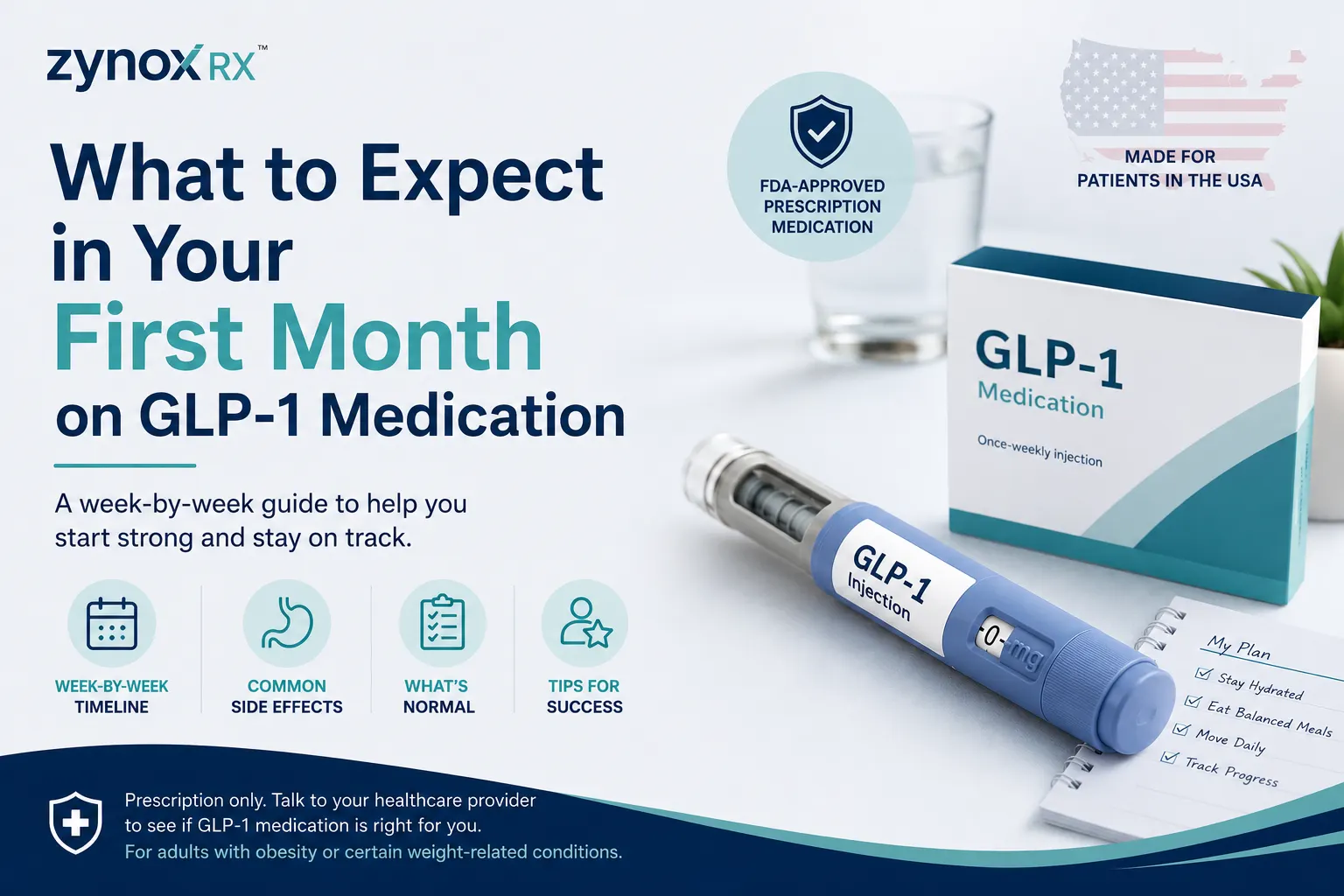
GLP-1 receptor agonists — including semaglutide and tirzepatide — are prescription medications that regulate appetite and blood sugar by mimicking a hormone your body produces naturally after eating. They are designed for adults with obesity, or with overweight plus at least one weight-related health condition, as part of a clinician-supervised weight management plan.
The first 30 days on a GLP-1 are an adjustment phase, not a results phase — and knowing that difference in advance is the single biggest predictor of whether patients stay on track. This guide walks you through what typically happens each week, which side effects are normal versus concerning, how much weight change is realistic in month one, and how to set yourself up for the stronger results that usually follow in months two through six.
What Are GLP-1 Medications and How Do They Work?
GLP-1 stands for glucagon-like peptide-1, a hormone released by your intestines after meals. GLP-1 receptor agonist medications mimic this hormone with three primary effects: they stimulate insulin release when blood sugar rises, slow the rate at which your stomach empties, and act on appetite-regulating centers in the brain to reduce hunger and food cravings (Collins & Costello, 2024).
Tirzepatide works slightly differently — it activates both GLP-1 and GIP (glucose-dependent insulinotropic polypeptide) receptors, which is why it's often described as a "dual agonist."
The practical effect most patients notice first isn't on the scale. It's a quieting of what many describe as "food noise" — the background mental chatter about eating. You feel full sooner, stay full longer, and think about food less.
At ZynoxRX, all GLP-1 prescriptions are issued by independent licensed US physicians after a health assessment, because these medications are appropriate for some patients and not others. You can learn more about how our process works.
Why Your Starting Dose Is Intentionally Low
Here's the expectation-reset that matters most: your first-month dose is deliberately sub-therapeutic.
GLP-1 medications follow a stepped dose-escalation schedule (called titration) specifically to reduce gastrointestinal side effects while your body adapts (Novo Nordisk, 2024; Eli Lilly, 2024). The starting dose is an on-ramp — it is not where the full weight-loss effect lives.
|
Medication |
Typical starting dose (weeks 1–4) |
Typical maintenance dose |
Time to reach maintenance |
|
Semaglutide |
0.25 mg once weekly |
Up to 2.4 mg once weekly |
~16–20 weeks |
|
Tirzepatide |
2.5 mg once weekly |
5–15 mg once weekly |
Varies; increased every 4 weeks as tolerated |
Source: FDA prescribing information for Wegovy® (Novo Nordisk, 2024) and Zepbound® (Eli Lilly, 2024). Your prescriber may adjust this schedule based on how you respond.
Patients who expect dramatic first-month results often get discouraged and quit right before the medication reaches an effective dose. If you understand month one as foundation-building, you're far more likely to reach the results documented in clinical trials — where semaglutide 2.4 mg produced an average 14.9% body weight reduction over 68 weeks, compared with 2.4% for placebo (Wilding et al., 2021).
Week-by-Week: What the First 30 Days Typically Look Like
Every patient responds differently, but most first months follow a recognizable pattern.
Week 1: The Adjustment Begins
Your first injection is a once-weekly subcutaneous shot, usually in the abdomen, thigh, or upper arm. Most patients find the injection itself far less intimidating than expected — the needle is small and the process takes seconds.
What you may notice:
- Reduced appetite within days. Many patients report feeling full after noticeably smaller portions by day 3–5.
- Mild nausea, often peaking a day or two after the injection. Not everyone experiences it — some patients feel nothing at all on the starting dose.
- Earlier satiety. Because gastric emptying slows, food sits longer and fullness arrives sooner.
What helps: eat smaller meals, eat slowly, stop at the first signal of fullness, and avoid greasy or fried foods, which are harder to tolerate with slowed digestion.
Week 2: Patterns Emerge
By the second injection, most patients have a sense of their personal response pattern — whether nausea shows up, when it peaks, and which foods sit well.
What you may notice:
- More consistent appetite reduction. Cravings, snacking urges, and "food noise" typically continue to fade.
- Digestive shifts. Constipation or, less commonly, diarrhea can appear as gut motility changes. Fiber, water, and daily walking help significantly.
- Possible mild fatigue as your calorie intake drops. Prioritize protein at every meal to counter this.
Week 3: Momentum Becomes Noticeable
What you may notice:
- Side effects typically begin easing as your body adapts to the dose.
- First measurable changes. Some patients see initial movement on the scale in this window; others notice clothes fitting differently before the scale moves. Both are normal.
- A common pitfall appears: undereating. With appetite suppressed, some patients eat too little — which can cost you muscle mass and energy. Aim for structured, protein-forward meals even when you're not hungry.
Week 4: Foundation Set
What you may notice:
- Routine feels established. Injection day, meal rhythm, and hydration habits are usually second nature by now.
- Modest, meaningful weight change. Many patients see a change of roughly 2–6 lbs by the end of month one, though results vary widely by individual, starting weight, and metabolic factors.
- Preparation for dose escalation. At your check-in, your prescriber will assess tolerance and typically step you up to the next dose — where stronger effects generally begin.
Common Side Effects in the First Month (and How to Manage Them)
Gastrointestinal side effects are the most common class effect of GLP-1 medications, and they are most likely to appear during the first four weeks and around dose increases. In a pooled analysis of the STEP 1–3 clinical trials, nausea affected 43.9% of semaglutide patients (versus 16.1% on placebo), diarrhea 29.7%, and vomiting 24.5% — but the large majority of events were mild to moderate and resolved over time. Only 0.8–4.5% of trial participants discontinued treatment because of gastrointestinal effects (Wharton et al., 2022).
|
Side effect |
How common |
What typically helps |
|
Nausea |
Most common; often 1–2 days post-injection |
Smaller meals, bland foods, ginger, avoiding greasy/fried food, not lying down after eating |
|
Constipation |
Common |
25–30 g fiber daily, 2–3 L water, daily movement |
|
Diarrhea |
Less common |
Hydration, temporary low-fat diet, electrolytes |
|
Fatigue |
Occasional |
Adequate protein (roughly 0.7–1 g per lb of goal body weight, per your provider), consistent sleep |
|
Injection-site irritation |
Occasional |
Rotate injection sites weekly |
Two points worth knowing:
- Side effects are not required for the medication to work. The same pooled STEP analysis found that weight loss was largely independent of whether patients experienced gastrointestinal side effects (Wharton et al., 2022). No nausea does not mean no results.
- Your titration schedule is adjustable. If side effects are disruptive, your prescriber can hold your current dose longer before escalating — a routine and effective adjustment.
How Much Weight Can You Realistically Lose in Month One?
Honest answer: modest amounts — typically in the range of 2–6 lbs, sometimes more, sometimes less. Results vary by individual, and the first month is not representative of the medication's full effect, because you're on the lowest dose.
For context on where the trajectory leads: in the 68-week STEP 1 trial, adults taking semaglutide 2.4 mg alongside lifestyle changes lost an average of 14.9% of body weight, and 86.4% achieved at least a 5% reduction (Wilding et al., 2021). That trajectory builds gradually across months two through six as dosing reaches the therapeutic range.
If the scale barely moves in month one, that is not a failure signal. Appetite change, portion change, and habit change in month one are the leading indicators that predict later results.
Five Habits That Multiply Your First-Month Results
GLP-1 medications are approved as an adjunct to diet and physical activity — not a replacement for them (Novo Nordisk, 2024). The patients who see the strongest long-term outcomes typically build these habits in month one:
- Protein at every meal. Rapid weight loss without adequate protein can cost lean muscle. Ask your provider for a personal target.
- Resistance training 2–3x per week. Even bodyweight exercise helps preserve muscle while fat comes off.
- Hydration. Reduced appetite often means reduced fluid intake without you noticing. Aim for consistent water intake throughout the day.
- Consistent sleep. Poor sleep disrupts the same appetite hormones the medication is helping regulate.
- Track more than weight. Log energy, appetite, measurements, and how clothes fit — the scale is the slowest-moving indicator in month one.
When to Contact Your Provider
Most first-month side effects are mild and manageable at home. Contact your care team promptly if you experience:
- Persistent vomiting or inability to keep fluids down
- Severe or worsening abdominal pain, especially radiating to the back (a possible sign of pancreatitis)
- Signs of dehydration: dizziness, dark urine, reduced urination
- Signs of an allergic reaction: rash, swelling of the face or throat, difficulty breathing
- Severe pain in the upper right abdomen (possible gallbladder issue)
- Symptoms of low blood sugar if you also take diabetes medication: shakiness, sweating, confusion
Seek emergency care for any symptoms of a severe allergic reaction or severe, unrelenting abdominal pain.
Who Should Not Take GLP-1 Medications?
GLP-1 medications are not appropriate for everyone. Per FDA prescribing information, they should not be used by people with (Novo Nordisk, 2024; Eli Lilly, 2024):
- A personal or family history of medullary thyroid carcinoma (MTC)
- Multiple Endocrine Neoplasia syndrome type 2 (MEN 2)
- A previous serious hypersensitivity reaction to the medication or its components
- Pregnancy, or plans to become pregnant — GLP-1 medications should be discontinued at least 2 months before a planned pregnancy. They are also not recommended while breastfeeding; discuss with your physician.
Additional caution and physician evaluation are required if you have a history of pancreatitis, gallbladder disease, diabetic retinopathy, severe gastrointestinal disease (such as gastroparesis), or if you take insulin or sulfonylureas. This list is not exhaustive — only a licensed physician reviewing your full health history can determine whether a GLP-1 is appropriate for you.
Medical Disclaimer: The information on this page is for educational purposes only and does not constitute medical advice. Individual results may vary, and no outcomes are guaranteed. Compounded GLP-1 medications are not FDA-approved as finished products and are not equivalent to brand-name Ozempic®, Wegovy®, Mounjaro®, or Zepbound®. Please consult a qualified, licensed medical practitioner before starting any weight management medication to determine whether it is suitable for your specific health conditions and concerns.
Frequently Asked Questions
How quickly does a GLP-1 medication start working?
Appetite effects often begin within the first week — many patients notice reduced hunger and earlier fullness within days of the first injection. Measurable weight change usually takes 3–4 weeks or longer, because the starting dose is intentionally low. Results vary by individual.
Is it normal to feel no side effects in the first month?
Yes. Many patients on the starting dose experience little or no nausea, and clinical data show weight loss occurs largely independently of side effects (Wharton et al., 2022). Absence of side effects does not mean the medication isn't working.
What foods should I avoid during my first month on a GLP-1?
There is no strictly forbidden list, but greasy, fried, and very rich foods are the most common nausea triggers because GLP-1s slow stomach emptying. Most patients tolerate smaller, protein-forward meals with vegetables and whole grains best. Alcohol may also be harder to tolerate; discuss limits with your provider.
What happens if I miss a weekly dose?
Guidance depends on the specific medication and how many days have passed, so follow your prescriber's instructions or the medication's official patient information. As a general rule, never take two doses close together to "catch up" without medical guidance.
Why am I not losing weight in my first month?
Usually because the starting dose is sub-therapeutic by design. Dose escalation over the following weeks is where clinical-trial-level results were achieved (Wilding et al., 2021). If appetite hasn't changed at all after your first month, raise it with your provider — your titration plan may need adjusting.
Do I still need to diet and exercise on a GLP-1?
Yes. These medications are FDA-approved as an adjunct to a reduced-calorie diet and increased physical activity (Novo Nordisk, 2024). Nutrition and resistance training also protect lean muscle during weight loss, which matters for keeping the weight off.
Ready to find out if a GLP-1 is right for you? ZynoxRX offers a free 2-minute eligibility assessment reviewed by independent licensed US physicians. If you qualify, medication ships directly to your door with ongoing clinical supervision. Check your eligibility →
References
Collins, L., & Costello, R. A. (2024). Glucagon-like peptide-1 receptor agonists. In StatPearls. StatPearls Publishing. https://www.ncbi.nlm.nih.gov/books/NBK551568/
Eli Lilly and Company. (2024). Zepbound (tirzepatide) prescribing information. U.S. Food and Drug Administration. https://www.accessdata.fda.gov/drugsatfda_docs/label/2023/217806s000lbl.pdf
Novo Nordisk. (2024). Wegovy (semaglutide) prescribing information. U.S. Food and Drug Administration. https://www.accessdata.fda.gov/drugsatfda_docs/label/2021/215256s000lbl.pdf
Wharton, S., Calanna, S., Davies, M., Dicker, D., Goldman, B., Lingvay, I., Mosenzon, O., Rubino, D. M., Thomsen, M., Wadden, T. A., & Pedersen, S. D. (2022). Gastrointestinal tolerability of once-weekly semaglutide 2.4 mg in adults with overweight or obesity, and the relationship between gastrointestinal adverse events and weight loss. Diabetes, Obesity and Metabolism, 24(1), 94–105. https://doi.org/10.1111/dom.14551
Wilding, J. P. H., Batterham, R. L., Calanna, S., Davies, M., Van Gaal, L. F., Lingvay, I., McGowan, B. M., Rosenstock, J., Tran, M. T. D., Wadden, T. A., Wharton, S., Yokote, K., Zeuthen, N., & Kushner, R. F. (2021). Once-weekly semaglutide in adults with overweight or obesity. New England Journal of Medicine, 384(11), 989–1002. https://doi.org/10.1056/NEJMoa2032183