Semaglutide vs. Tirzepatide: Which GLP-1 Is Right for You?
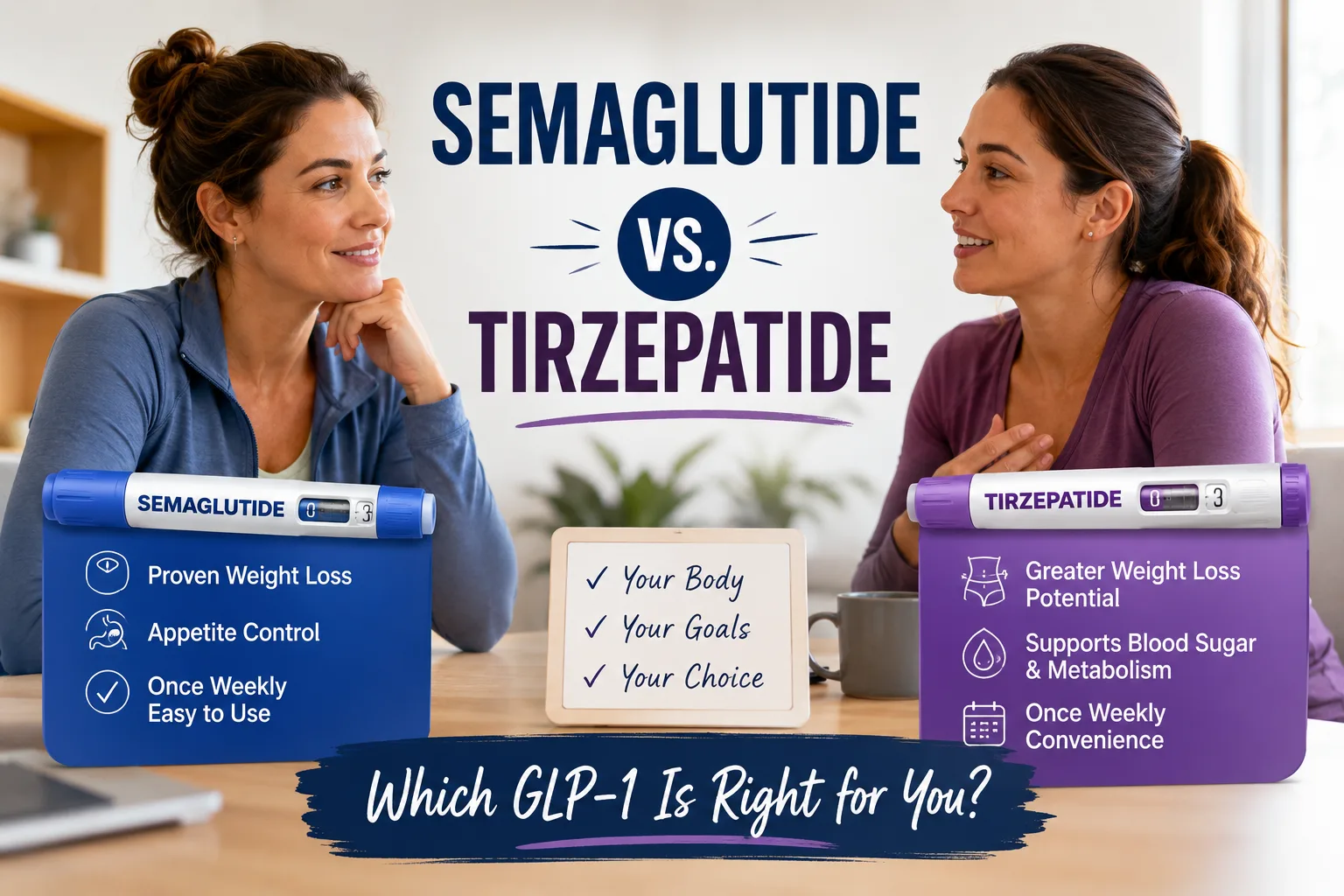
Semaglutide and tirzepatide are the two most-prescribed GLP-1 medications in the United States, and they are not interchangeable. Semaglutide activates one gut-hormone receptor; tirzepatide activates two. That single difference shapes how much weight most people lose, how the side effects feel, what the medication costs, and — as of 2025 — which one now has direct head-to-head trial evidence behind it.
This guide compares both medications on the factors that actually decide the choice: weight-loss results, safety and tolerability, cost and insurance in 2026, and the specific patient profiles each one suits best. Every clinical claim below is cited inline so you can check the source yourself.
A note before you read: this page is educational. It is not a substitute for a consultation. Neither medication is right for everyone, and the "better" drug on paper is not always the better drug for your body. Talk to a qualified prescriber before starting or switching.
Semaglutide vs. Tirzepatide at a Glance
|
Feature |
Semaglutide |
Tirzepatide |
|
Drug class |
GLP-1 receptor agonist (single) |
Dual GIP + GLP-1 receptor agonist |
|
Weight-loss brand |
Wegovy |
Zepbound |
|
Diabetes brand |
Ozempic (injection), Rybelsus (pill) |
Mounjaro |
|
Average weight loss (head-to-head, 72 wks) |
13.7% of body weight |
20.2% of body weight |
|
How it's taken |
Weekly injection or daily pill |
Weekly injection |
|
FDA weight-loss approval age |
12 and older |
12 and older |
|
Boxed warning |
Thyroid C-cell tumors |
Thyroid C-cell tumors |
|
Retail price (weight-loss brand, monthly) |
~$1,350–$1,640 |
~$1,271 |
Weight-loss figures from the SURMOUNT-5 head-to-head trial (Aronne et al., NEJM, 2025). Pricing from GoodRx, April 2026, via TeleDirectMD. See references.
How Each Medication Works
Both medications imitate hormones your gut releases after you eat — hormones that tell your brain you're full and help regulate blood sugar. The difference is how many of those hormone signals each drug activates.
Semaglutide is a GLP-1 receptor agonist. It mimics one hormone, glucagon-like peptide-1 (GLP-1), which slows how quickly your stomach empties, reduces appetite, and prompts insulin release when blood sugar rises (Obesity Medicine Association, 2026).
Tirzepatide is a dual agonist. It activates the GLP-1 receptor and a second one — the glucose-dependent insulinotropic polypeptide (GIP) receptor (Obesity Medicine Association, 2026). Adding GIP appears to layer on extra appetite suppression and metabolic effect that a single-receptor drug can't provide on its own, which is the leading explanation for tirzepatide's larger average results.
Here's what that means in practice: neither drug is a stimulant, and neither "burns fat" directly. Both work primarily by reducing how much you want to eat — many patients describe a quieting of "food noise," the intrusive background thoughts about food (Obesity Medicine Association, 2026). Weight loss follows from a sustained reduction in calorie intake, which is why both are prescribed alongside diet and physical activity, not instead of them.
Weight Loss: What the Head-to-Head Trial Showed
For years, comparing these two drugs meant comparing separate trials with different patients — an indirect comparison at best. That changed with SURMOUNT-5, the first large, direct, head-to-head trial, published in the New England Journal of Medicine in May 2025.
The result was not ambiguous.
In SURMOUNT-5, 751 adults with obesity (but without diabetes) were randomly assigned to receive either tirzepatide or semaglutide at their maximum tolerated doses for 72 weeks. At the end:
- Tirzepatide produced an average body-weight reduction of 20.2%.
- Semaglutide produced an average reduction of 13.7% (Aronne et al., 2025).
That is a 6.5-percentage-point gap. For a 250-pound adult, that's roughly 50 pounds lost on tirzepatide versus about 33 pounds on semaglutide (Shreveport Direct Care, 2026). Tirzepatide also produced greater waist-circumference reduction — 18.4 cm versus 13.0 cm — and larger improvements in blood pressure and other cardiometabolic markers (American College of Cardiology, 2025).
But context matters here. Semaglutide's 13.7% is not a weak result — it far exceeds anything achievable with earlier non-surgical weight treatments. The SURMOUNT-5 investigators noted the numbers were "almost identical" to what each drug showed in its own earlier trials, so this confirmed expectations rather than overturning them (Weill Cornell Medicine, 2025). Independent clinicians made the same point: the outcome largely reflected the dual-mechanism advantage everyone anticipated (TCTMD, 2025).
The honest takeaway: on average, tirzepatide produces more weight loss. That does not mean it will produce more weight loss for you. Individual response varies widely, and a meaningful number of semaglutide patients lose as much as the average tirzepatide patient. Averages guide expectations; they don't predict individuals.
Side Effects and Safety
The two medications share a strikingly similar safety profile — same drug family, same core risks.
Common side effects (both drugs)
The most common side effects for both are gastrointestinal and tend to be worst when starting treatment or increasing the dose, then ease as your body adjusts (Fella Health, 2025). These include:
- Nausea
- Vomiting
- Diarrhea
- Constipation
- Reduced appetite (the intended effect, but it can be uncomfortable)
In an analysis of over 400,000 online posts from people using these medications, roughly 43.5% reported at least one side effect, with nausea the most common at about 36.9% (medRxiv, 2026). Note that this reflects self-reported experience, not a controlled trial — real-world reporting tends to run higher than trial rates.
How the two differ on tolerability
Some data suggest higher doses of tirzepatide may carry a somewhat higher rate of gastrointestinal issues (Healthon, 2026). Yet in SURMOUNT-5, the opposite showed up on the metric that matters most — discontinuation: gastrointestinal side effects severe enough to stop treatment occurred more often with semaglutide (5.6%) than tirzepatide (2.7%) (American College of Cardiology, 2025). The practical read: side-effect burden is comparable, individual, and heavily dependent on how carefully the dose is escalated.
Rare but serious risks (both drugs)
Both medications carry an FDA boxed warning for the risk of thyroid C-cell tumors, including medullary thyroid carcinoma (MTC), based on animal studies (Fella Health, 2025; Healthon, 2026). Other rare but serious risks include pancreatitis, gallbladder problems, and kidney problems (Healthon, 2026). Because both slow digestion, they can also change how your body absorbs other oral medications — worth flagging to your prescriber if you take other daily medicines (Healthon, 2026).
Who Should Not Take These Medications
This section is not optional reading. Both semaglutide and tirzepatide are inappropriate or require specialist caution for certain people. Do not start either medication if any of the following applies to you — discuss it with a qualified prescriber first:
- Personal or family history of medullary thyroid carcinoma (MTC) or Multiple Endocrine Neoplasia syndrome type 2 (MEN 2) — both are contraindications tied to the boxed warning (Healthon, 2026).
- Pregnancy or breastfeeding — neither medication is recommended, and this should be stated explicitly rather than assumed obvious (Healthon, 2026).
- A history of pancreatitis — use requires careful medical judgment given the pancreatitis risk (Healthon, 2026).
- Severe gastrointestinal disease, including severe gastroparesis — tirzepatide specifically is not recommended in this group (Fella Health, 2025).
- Known allergy to the medication or its components.
- Gallbladder disease — discuss your history, as both drugs are associated with gallbladder problems (Healthon, 2026).
If you take other oral medications, have kidney disease, or have any history of the above, that is a conversation to have before a prescription is written, not after.
Cost and Insurance in 2026
Price is often the deciding factor, and the 2026 landscape shifted meaningfully.
Retail (cash) pricing
Without insurance, branded weight-loss GLP-1s remain expensive:
- Wegovy (semaglutide): approximately $1,350–$1,640 per month retail (GoodRx, April 2026).
- Zepbound (tirzepatide): approximately $1,271 per month retail (GoodRx, April 2026).
Manufacturer and coupon programs reduce these somewhat — Wegovy to roughly $199–$349/month and Zepbound to around $995/month — but that is still $2,400–$12,000 per year out of pocket (TeleDirectMD, 2026). A once-daily Wegovy pill launched in 2026 with self-pay pricing starting near $149/month for the lowest dose, rising with higher doses (United Medicare Advisors, 2026).
The 2026 Medicare change
Historically, Medicare Part D was barred from covering GLP-1s prescribed solely for weight loss. As of July 1, 2026, a pilot changed that: the Medicare GLP-1 Bridge program provides eligible Part D enrollees with Wegovy, Zepbound, or the new Foundayo pill for a flat $50 monthly copay for weight loss, running through December 31, 2027 (AARP, 2026; NPR, 2026).
Two caveats matter. First, eligibility depends on BMI criteria (generally BMI ≥30, or ≥27 with certain conditions) attested at the time therapy started (Healthline, 2026). Second, the $50 copay does not count toward your Part D deductible or the $2,100 annual out-of-pocket cap, and the program is scheduled to end in 2027 — which raises the real possibility of gaining access and then losing it (NPR, 2026).
For commercial insurance, coverage for weight loss (as opposed to diabetes) remains restrictive and typically requires prior authorization, often with a documented BMI threshold and months of prior lifestyle intervention (TeleDirectMD, 2026).
Bottom line on cost: if you have Medicare Part D and qualify for the Bridge, both drugs land at the same $50 copay — so cost stops being the tiebreaker and efficacy or tolerability decides. If you're paying cash, tirzepatide's retail price currently runs somewhat lower than Wegovy's, though coupon math can flip that. Verify current pricing before you commit; these numbers move.
Which One Is Right for You?
There is no universal winner. The right choice depends on your goals, health history, and circumstances. Here's how clinicians tend to weigh it:
Tirzepatide may be the stronger fit if:
- Your primary goal is maximizing weight loss and you have no contraindication — the head-to-head data favor it on average (Aronne et al., 2025).
- You tolerate injections and don't need an oral option.
Semaglutide may be the stronger fit if:
- You want or need an oral (pill) option — semaglutide offers one; tirzepatide does not (The Difference Between Semaglutide and Tirzepatide, 2026).
- You have established cardiovascular disease — certain semaglutide formulations carry cardiovascular risk-reduction approval, which may point your prescriber toward it (Healthon, 2026).
- You value the longer real-world track record — semaglutide has been in wide use longer (The Difference Between Semaglutide and Tirzepatide, 2026).
For most people, the deciding factors end up being: what your insurance covers, how your body tolerates the specific drug, whether you need a pill or can use an injection, and your prescriber's read of your full medical history. Efficacy on paper is one input — not the whole decision.
The Bottom Line
Tirzepatide produces more weight loss on average and now has direct head-to-head evidence behind it. Semaglutide is highly effective, offers a pill option, has a longer track record, and carries cardiovascular approvals that matter for some patients. Both share the same core risks and the same boxed warning. The genuinely right answer is the one a qualified prescriber reaches after reviewing your history, goals, and coverage — not a number in a trial.
If you're considering either medication, the next step is a medical consultation to confirm you're a candidate, rule out contraindications, and match the medication to your situation.
Medical disclaimer: The information on this page is for educational purposes only and does not constitute medical advice. Individual results vary. GLP-1 medications carry serious risks and are not appropriate for everyone. Please consult a qualified medical practitioner before starting, stopping, or switching any medication to determine what is suitable for your specific health condition.
[CTA: Speak with a licensed provider to see if a GLP-1 is right for you →]
Frequently Asked Questions
Is tirzepatide better than semaglutide?
On average, tirzepatide produces greater weight loss — 20.2% versus 13.7% at 72 weeks in the SURMOUNT-5 head-to-head trial (Aronne et al., 2025). "Better" for you, though, depends on your health history, tolerability, insurance, and whether you need a pill option. Semaglutide remains highly effective and is the stronger choice for some patients.
What is the difference between Wegovy and Zepbound?
Wegovy contains semaglutide (a single GLP-1 agonist); Zepbound contains tirzepatide (a dual GIP/GLP-1 agonist). Both are FDA-approved specifically for chronic weight management. The main practical differences are mechanism, average weight loss, and cost.
Can I switch from semaglutide to tirzepatide?
Some patients do switch — often when weight loss plateaus or side effects are hard to tolerate — but this should only be done under medical supervision. A prescriber will manage the transition and dose escalation. Do not switch on your own.
Do semaglutide and tirzepatide have the same side effects?
Largely, yes. Both most commonly cause gastrointestinal effects — nausea, vomiting, diarrhea, constipation — that are usually worst early and improve over time (Fella Health, 2025). Both also carry a boxed warning for thyroid C-cell tumors. Individual tolerability varies.
Will insurance cover semaglutide or tirzepatide for weight loss in 2026?
It depends. As of July 1, 2026, eligible Medicare Part D members can get Wegovy or Zepbound for weight loss at a $50/month copay through the GLP-1 Bridge pilot, running through 2027 (AARP, 2026). Commercial coverage for weight loss remains restrictive and usually requires prior authorization (TeleDirectMD, 2026).
Which is cheaper, semaglutide or tirzepatide?
At retail without insurance, Zepbound (tirzepatide) recently ran somewhat lower (~$1,271/month) than Wegovy (semaglutide, ~$1,350–$1,640/month) (GoodRx, April 2026). Coupons and manufacturer programs can change that ranking, and Medicare Bridge-eligible patients pay the same $50 for either. Verify current pricing before deciding.
How long do I need to stay on a GLP-1?
These are generally long-term medications. Most studies show that many people regain lost weight after stopping (NPR, 2026), so treatment is typically ongoing and paired with sustained lifestyle changes. Discuss a long-term plan with your prescriber.
References
American College of Cardiology. (2025, July 10). SURMOUNT-5: Greater loss of weight, waist circumference with tirzepatide than semaglutide. https://www.acc.org/Latest-in-Cardiology/Journal-Scans/2025/07/10/09/09/SURMOUNT-5
Aronne, L. J., et al. (2025). Tirzepatide versus semaglutide in adults with obesity (SURMOUNT-5). New England Journal of Medicine, 393(1), 26–36.
AARP. (2026). Medicare starts offering $50 GLP-1 doses in July. https://www.aarp.org/medicare/glp1-weight-loss-copay-program/
Fella Health. (2025, October). Does tirzepatide make you feel sick? Nausea and side effects. https://www.fellahealth.com/guide/does-tirzepatide-make-you-feel-sick
Healthline. (2026, June 24). Wegovy, Zepbound: $50 GLP-1 drugs are coming for Medicare recipients. https://www.healthline.com/health-news/low-cost-wegovy-zepbound-medicare-glp-1-pilot-program
Healthon. (2026, February). Tirzepatide vs semaglutide: Key differences, benefits, and side effects. https://healthon.com/blogs/journal/tirzepatide-vs-semaglutide-differences-results-side-effects-and-how-to-choose
medRxiv. (2026, March). Self-reported side effects of semaglutide and tirzepatide in online communities. https://www.medrxiv.org/content/10.64898/2026.03.12.26348253v1
NPR. (2026, May 6). Some Medicare beneficiaries can now get popular obesity drugs for $50 a month. https://www.npr.org/2026/05/06/nx-s1-5812662/medicare-bridge-glp1-drugs-copay
Obesity Medicine Association. (2026, March). Tirzepatide vs semaglutide: A comprehensive comparison for providers. https://obesitymedicine.org/blog/tirzepatide-vs-semaglutide-a-comprehensive-comparison-for-providers/
Shreveport Direct Care. (2026, May). Tirzepatide vs. semaglutide: What the head-to-head trial showed. https://www.shreveportdirectcare.com/blog/tirzepatide-vs-semaglutide-surmount-5-results
TCTMD. (2025, July 28). Tirzepatide tops semaglutide for weight loss: SURMOUNT-5. https://www.tctmd.com/news/tirzepatide-tops-semaglutide-weight-loss-surmount-5
TeleDirectMD. (2026, July 1). GLP-1 weight loss cost 2026: Wegovy, Zepbound, insurance vs. cash-pay. https://teledirectmd.com/cost/weight-loss-glp1-cost/
United Medicare Advisors. (2026, April 30). Medicare GLP-1 coverage in 2026 and 2027: What to know now. https://unitedmedicareadvisors.com/blog/medicare-news/medicare-glp-1-drugs-2026/
Weill Cornell Medicine. (2025, May). Head-to-head trial compares weight loss drugs. https://news.weill.cornell.edu/news/2025/05/head-to-head-trial-compares-weight-loss-drugs