Foods to Avoid on Semaglutide and What to Eat Instead
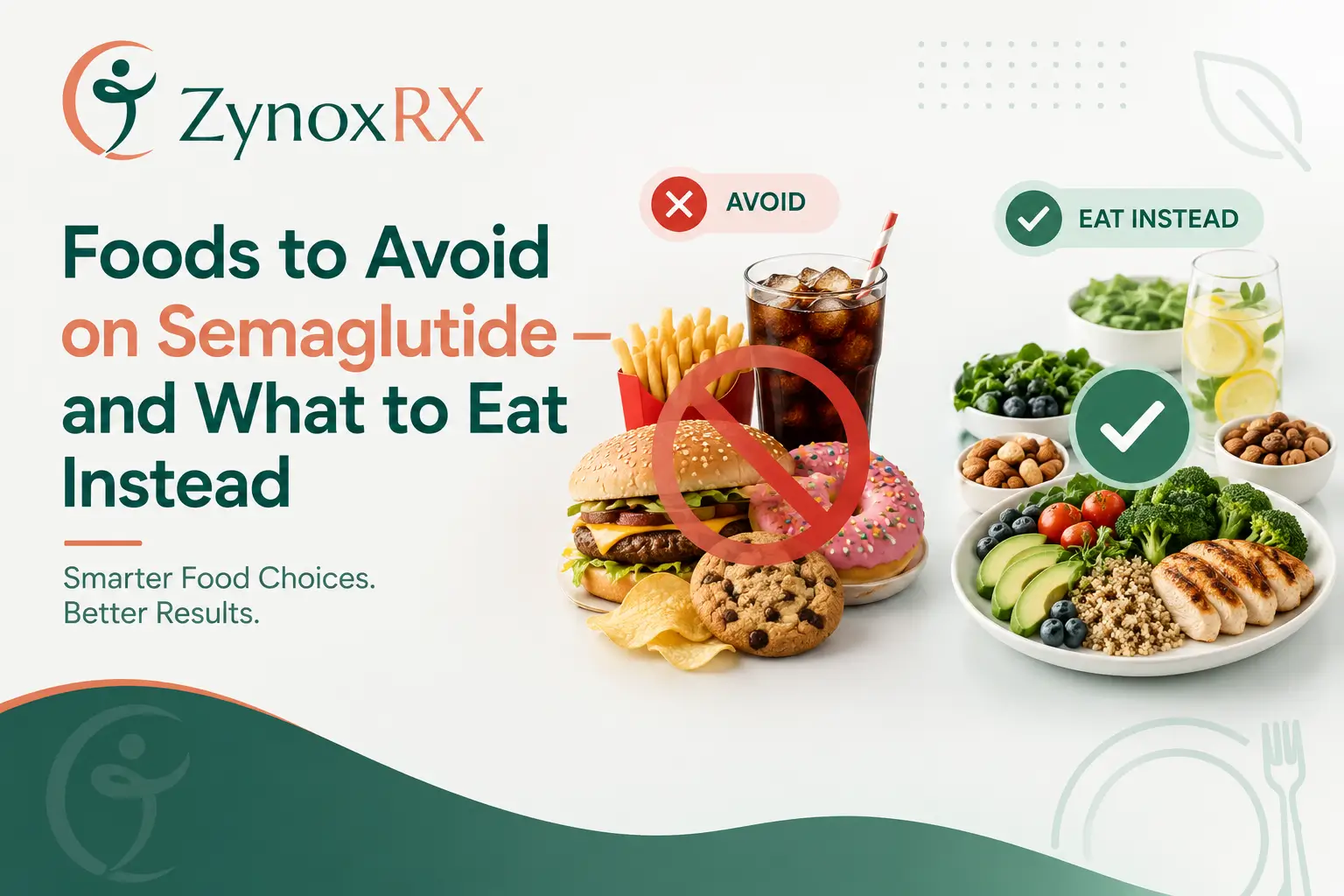
Semaglutide is a GLP-1 receptor agonist prescribed for chronic weight management and type 2 diabetes. It works in part by slowing the rate at which food leaves your stomach, which is also the reason certain meals suddenly feel intolerable on it.
This guide is written for people who have already started treatment, are titrating up a dose, or are about to. If you are searching for foods to avoid on semaglutide because you spent last night nauseated, the list below is organised by why each item is a problem, not just that it is.
You will get three things: which foods are worth limiting and for how long, which restrictions circulating online are not supported by evidence, and what to eat instead so you protect muscle while you lose fat.
The Short Answer
There are no foods that are medically forbidden on semaglutide. The foods most likely to cause problems are high-fat and fried meals, large portions of refined sugar, alcohol, carbonated drinks, and very spicy dishes — because each one compounds the delayed stomach emptying the medication already causes. Most people tolerate these again after the dose-escalation phase ends.
Why Food Choices Change on Semaglutide
Semaglutide is a synthetic analogue of glucagon-like peptide-1. It binds GLP-1 receptors and produces three effects relevant to eating: it stimulates glucose-dependent insulin secretion, it suppresses glucagon release, and it delays gastric emptying — the speed at which the stomach passes food into the small intestine (Novo Nordisk, 2025).
That third effect is the one your dinner notices.
Food that would normally clear your stomach in two hours may take considerably longer. Anything that independently slows gastric emptying — dietary fat is the strongest example — now stacks on top of a drug that is already doing the same thing. The result is the pressure, reflux, and nausea most patients describe in the first few weeks.
This is not a rare or unlucky reaction. In the STEP 1 trial, gastrointestinal disorders were reported by 74.2% of participants on semaglutide 2.4 mg versus 47.9% on placebo (Wilding et al., 2021). A pooled analysis of STEP 1–3 found nausea in 43.9% of participants, diarrhoea in 29.7%, vomiting in 24.5%, and constipation in 24.2% (Wharton et al., 2022).
Two details from that pooled analysis matter more than the headline numbers, and almost no article on this topic mentions them:
-
98.1% of those events were mild or moderate. Severe GI events affected 4.1% of the semaglutide group.
-
They cluster during dose escalation. The cumulative incidence of a first GI event plateaued after roughly week 20.
At ZynoxRX, this is why our providers front-load dietary coaching at the start of a titration rather than after a patient has already had a bad week. The avoid list is at its longest in month one and gets shorter from there.
Tier 1: Foods to Limit While Your Dose Is Escalating
These are comfort and tolerance issues, not safety issues. Nothing here is permanently off-limits. Treat this as a temporary list you re-test as you stabilise.
High-fat and fried foods
Fat is the slowest macronutrient to leave the stomach. Adding a high-fat meal to a drug that already delays gastric emptying is the most reliable way to trigger nausea, fullness that lasts for hours, and reflux.
Common triggers: fried chicken, french fries, pizza, cream-based sauces, full-fat dairy in volume, fast-food burgers, pastries, and anything battered.
This does not mean a no-fat diet. Fat is required for absorbing vitamins A, D, E, and K, and for satiety. The distinction is portion and concentration: half an avocado on a salad behaves very differently from a plate of onion rings. Aim to keep fat distributed across the day rather than concentrated in one meal.
Refined sugar and sugary drinks
Large amounts of refined sugar and sugar-sweetened beverages tend to cause GI upset on GLP-1 therapy, and they add calories without protein, fibre, or micronutrients — which matters far more when your total intake has dropped.
Sodas, sweetened coffee drinks, fruit juice, candy, and commercial baked goods are the usual sources.
For patients also taking a sulfonylurea or insulin, sharp glucose swings are a clinical consideration rather than just a dietary one. Discuss it with your prescriber.
Carbonated drinks
Carbonation introduces gas into a stomach that is already emptying slowly. Patients frequently report bloating and early fullness, and sparkling water can displace the plain fluid intake you need. Flat water, herbal tea, and broth are better vehicles for hydration during titration.
Very spicy foods
Capsaicin sits in contact with the gastric lining for longer when emptying is delayed, which can produce burning and heartburn that outlast the meal. Tolerance here is highly individual. Some patients lose spicy food entirely for a month; others never notice a difference.
Large volumes of raw, coarse fibre
Fibre is genuinely useful on semaglutide, particularly for the roughly one in four patients who experience constipation. But adding it fast is a mistake.
Large raw salads, whole raw cruciferous vegetables, and sudden high-fibre supplementation can produce bloating and cramping in a slow-moving gut. Increase fibre gradually, cook vegetables rather than eating them raw during the first weeks, and raise fluid intake at the same time. Commonly cited adequate-intake targets are about 25 g/day for adult women and 38 g/day for adult men (Institute of Medicine, 2005) — worth reaching, but not in week one.
Tier 2: Things to Avoid on Semaglutide for Medical Reasons
This tier is different. These are not about comfort.
Alcohol
Alcohol is the item on this page with the strongest case for genuine restriction, for four separate reasons:
-
It irritates the gastric lining at exactly the point where the drug is already causing discomfort.
-
It raises hypoglycaemia risk. The Ozempic prescribing information notes that patients taking semaglutide alongside an insulin secretagogue such as a sulfonylurea, or alongside insulin, face increased risk of hypoglycaemia including severe hypoglycaemia (Novo Nordisk, 2025). Alcohol independently impairs the liver's ability to release glucose. If you take either of those medications, drinking is a conversation to have with your prescriber before you have it.
-
Pancreatitis considerations. Acute pancreatitis is a rare but recognised adverse event with GLP-1 receptor agonists, and heavy alcohol use is an established independent risk factor for it.
-
It works against the goal. Alcohol contributes calories with no protein and tends to loosen restraint around food.
If you drink, keep intake low, never on an empty stomach, and stop entirely if you develop severe or persistent abdominal pain.
Sugar alcohols, if you are getting diarrhoea
Sorbitol, mannitol, xylitol, and maltitol are common in sugar-free candy, protein bars, and "keto" products. They are poorly absorbed and osmotically active, which can worsen diarrhoea in patients already experiencing it. Scan ingredient lists for names ending in -ol if loose stools are your main symptom.
Under-eating protein — the most costly thing to avoid
This is the omission that shows up in almost every competing article, and it is the one with the longest consequences.
Semaglutide reduces appetite substantially. When total intake falls without protein being deliberately protected, the food that gets cut first is usually protein, because it is the least appealing thing to eat when nauseated.
In the STEP 1 DXA sub-study, total lean body mass decreased in absolute terms, though lean mass as a proportion of total body mass increased (Wilding et al., 2021). Absolute lean mass loss is not unique to GLP-1 therapy — it accompanies rapid weight loss generally — but it is the outcome most worth defending, because lean mass drives resting metabolic rate and long-term weight maintenance.
Practical approach used by our clinical team:
-
Eat protein first at every meal, while your appetite is at its highest point in the meal.
-
Many obesity medicine clinicians target roughly 1.0–1.5 g of protein per kg of body weight per day during active weight loss. Your provider should set your specific number based on your weight, kidney function, and comorbidities.
-
Use low-volume, high-protein forms on low-appetite days: Greek yoghurt, cottage cheese, eggs, tuna or salmon pouches, tofu, a protein shake.
-
Pair protein intake with resistance training two to three times weekly. Diet alone does not preserve muscle.
Skipping fluids
Nausea and reduced appetite reduce spontaneous drinking, and vomiting or diarrhoea accelerate fluid loss. Volume depletion on GLP-1 therapy has been associated with acute kidney injury in reported cases. Dehydration also worsens constipation and fatigue, which patients often misattribute to the medication itself.
Sip steadily across the day rather than drinking large volumes at once, which will make you feel full and displace food.
One timing note that is not about food
Because semaglutide delays gastric emptying, it has the potential to affect the absorption of oral medications taken at the same time (Novo Nordisk, 2025). Separately, pulmonary aspiration has been reported in patients on GLP-1 receptor agonists undergoing procedures under general anaesthesia or deep sedation. Tell any surgeon, anaesthetist, endoscopist, or dentist that you are on a GLP-1 medication well before a scheduled procedure, and follow their fasting instructions rather than standard ones.
Tier 3: Foods You've Been Told to Avoid That Usually Aren't the Problem
Several restrictions circulating in this space are not supported by evidence. Removing nutrient-dense food on a reduced-calorie intake carries its own cost.
|
Common claim |
What the evidence supports |
|---|---|
|
"Avoid carrots, beets, peas, and corn — they spike glucose." |
These are nutrient-dense vegetables with moderate glycaemic impact in normal portions. Blanket exclusion is not supported, and glycaemic index of a single food is a poor predictor of a mixed meal's effect. |
|
"Avoid eggs, red meat, and cruciferous vegetables to prevent sulfur burps." |
This appears in clinic blogs as practitioner observation, not clinical evidence. Eggs are a low-volume, high-quality protein source and are useful on GLP-1 therapy for most patients. If eggs specifically bother you, that is individual intolerance — not a class effect. |
|
"Avoid all fruit because of sugar." |
Whole fruit provides fibre, water, and micronutrients. Fruit juice is the item to limit, not fruit. |
|
"Avoid all carbohydrates." |
Refined carbohydrate in large portions is worth limiting. Whole grains, legumes, and starchy vegetables support fibre intake and energy on a reduced calorie load. |
|
"Avoid dairy." |
Full-fat dairy in volume may aggravate nausea. Low-fat Greek yoghurt and cottage cheese are among the more useful protein sources on this medication. |
|
"These restrictions are permanent." |
Most Tier 1 items become tolerable again after titration stabilises. Re-test rather than assume. |
What to Eat on Semaglutide Instead
The best things to eat on semaglutide share three characteristics: high protein density, low volume, and low fat concentration.
|
Instead of |
Choose |
Why it works |
|---|---|---|
|
Fried chicken |
Grilled or baked chicken breast |
Same protein, far less fat to slow emptying |
|
Pizza |
Thin-crust with lean protein, or a chicken-and-vegetable bowl |
Cuts the fat-and-refined-carb combination |
|
Soda or juice |
Water, herbal tea, broth |
Hydration without gas or glucose load |
|
Large raw salad |
Cooked or roasted vegetables |
Easier on a slow-moving gut |
|
Ice cream |
Greek yoghurt with berries |
Protein instead of fat and sugar |
|
Sugar-free protein bar with sugar alcohols |
Cottage cheese, boiled eggs, tuna pouch |
Avoids osmotic diarrhoea trigger |
|
Three large meals |
Four to five smaller meals |
Works with delayed emptying instead of against it |
|
Chips or crackers |
Nuts in a pre-measured portion |
Protein and fibre, but portion-controlled for fat |
How you eat matters as much as what. Eat slowly, stop at the first sign of fullness rather than at the plate being empty, and avoid lying down for at least an hour after eating.
How Your Avoid List Changes by Treatment Phase
GI adverse events concentrate during dose escalation and their cumulative incidence plateaus after roughly week 20 (Wharton et al., 2022). Your restriction list should follow that curve, not stay fixed.
|
Phase |
Typical experience |
Dietary priority |
|---|---|---|
|
Weeks 1–4 (starting dose) |
Nausea onset, appetite drop |
Strictest Tier 1 limits. Small meals. Bland, low-fat foods on bad days. Protein first. |
|
Weeks 5–16 (titration) |
Symptoms recur with each dose step |
Tighten Tier 1 for 3–5 days after each increase, then relax. Build fibre gradually. |
|
Week 17+ (maintenance) |
Most GI symptoms settle |
Re-test Tier 1 foods one at a time. Shift focus to protein adequacy and micronutrients. |
|
Any phase |
— |
Tier 2 items stay on the list throughout. |
Source: Wharton et al. (2022), Diabetes, Obesity and Metabolism. Individual response varies; this table describes typical trial patterns, not a prescription.
The Three-Question Tolerance Test
Before you cut a food permanently, run it through this:
-
Did it cause symptoms more than once? A single bad meal may have been portion size, eating speed, or where you were in your dosing week.
-
Did it cause symptoms at a normal portion, or only a large one? Most Tier 1 foods are dose-dependent, not binary.
-
Was it within 72 hours of a dose increase? If yes, re-test it two weeks later before deciding.
Keep a short food and symptom log for 7–10 days. Patterns become obvious quickly, and it gives your provider something concrete to work with at your next check-in.
Who Should Not Take Semaglutide
Diet is a secondary question if the medication is not appropriate for you in the first place. Semaglutide is contraindicated or requires specific caution in the following circumstances (Novo Nordisk, 2025):
-
Personal or family history of medullary thyroid carcinoma (MTC), or Multiple Endocrine Neoplasia syndrome type 2 (MEN 2) — contraindicated.
-
Known serious hypersensitivity to semaglutide or any product excipient — contraindicated.
-
Pregnancy, planned pregnancy, or breastfeeding. Semaglutide is not recommended during pregnancy, and weight loss offers no benefit to a developing pregnancy. Discontinuation is generally advised in advance of a planned pregnancy. Discuss contraception and timing with your provider.
-
History of pancreatitis. Semaglutide has not been studied in this population; alternative therapy should be considered.
-
Diabetic retinopathy. Patients with a history of diabetic retinopathy should be monitored, as rapid glycaemic improvement has been associated with temporary worsening.
-
History of gallbladder disease. Gallbladder-related events, principally cholelithiasis, occurred more often with semaglutide than placebo in STEP 1 (Wilding et al., 2021).
-
Severe gastrointestinal disease, including gastroparesis. Delayed gastric emptying may worsen existing motility disorders.
-
Concurrent insulin or sulfonylurea therapy. Dose reduction of the secretagogue may be required to reduce hypoglycaemia risk.
-
Upcoming surgery or any procedure requiring general anaesthesia or deep sedation. Inform your care team in advance.
Stop the medication and seek medical attention for severe, persistent abdominal pain (with or without vomiting), signs of an allergic reaction, or a neck lump, hoarseness, or difficulty swallowing.
Medical Disclaimer
The information on this page is for educational purposes only and does not constitute medical advice. Individual results vary. Semaglutide is a prescription medication and should only be used under the supervision of a licensed healthcare provider. Consult a qualified medical practitioner before starting, stopping, or changing any treatment, and before making significant dietary changes — particularly if you have diabetes, kidney disease, a history of pancreatitis or gallbladder disease, or take insulin or a sulfonylurea.
Compounded semaglutide is not an FDA-approved finished drug product and is not the same as, or equivalent to, Ozempic® or Wegovy®. Your prescribing provider will discuss the differences with you.
Considering treatment, or already on it and struggling with side effects? ZynoxRX connects you with independent licensed US physicians who manage titration and dietary tolerance together, not separately. Check your eligibility in 5 minutes — free →
Independent licensed physicians make all prescribing decisions. Individual results vary. No specific outcome is guaranteed.
Frequently Asked Questions
What foods should I avoid on semaglutide?
The foods most likely to cause problems are fried and high-fat meals, large portions of refined sugar, alcohol, carbonated drinks, and very spicy dishes. Each one compounds the delayed stomach emptying semaglutide causes. Most are temporary limits rather than permanent bans, and tolerance usually improves once dose escalation ends. Discuss persistent symptoms with your provider rather than restricting your diet further on your own.
Can I drink alcohol on semaglutide?
Alcohol is not a formal contraindication, but it is the item on the list with the strongest case for restriction. It irritates the stomach, adds calories without protein, and raises hypoglycaemia risk in patients also taking insulin or a sulfonylurea. Heavy use is also an independent risk factor for pancreatitis. If you drink, keep it low and never on an empty stomach.
What foods should I avoid on semaglutide for weight loss specifically?
Beyond the nausea triggers, the categories that most undermine results are calorie-dense, nutrient-poor foods: sugar-sweetened drinks, alcohol, refined snacks, and fried food. On a reduced total intake, every calorie has to carry protein, fibre, or micronutrients. The bigger risk to your results, though, is not eating enough protein — that is what drives lean mass loss.
How long do I have to avoid these foods?
In pooled trial data, the cumulative incidence of a first gastrointestinal adverse event plateaued after roughly week 20 (Wharton et al., 2022). Most patients find Tier 1 foods become tolerable again after their dose stabilises. Re-test one food at a time rather than assuming a restriction is permanent.
What are the best things to eat on semaglutide?
Prioritise high-protein, low-volume, moderate-fat foods: chicken, fish, eggs, Greek yoghurt, cottage cheese, tofu, legumes, and lean beef. Add cooked non-starchy vegetables, whole grains, and whole fruit as tolerated. Eat protein first, keep meals small and frequent, and drink steadily across the day.
Do I need to avoid eggs, carrots, or cruciferous vegetables?
No. These restrictions appear in some clinic blogs without supporting evidence. Eggs in particular are a useful low-volume protein source on GLP-1 therapy. If a specific food consistently bothers you at normal portions, that is individual intolerance and worth noting — but there is no reason to exclude these categories preemptively.
Why am I still nauseated even though I'm avoiding all these foods?
Diet reduces the severity of GI side effects; it does not eliminate them. Nausea affected 43.9% of participants in pooled STEP 1–3 data regardless of diet (Wharton et al., 2022), and it is most common during dose escalation. Eating speed, portion size, lying down after meals, and dehydration all contribute. If symptoms are severe, persistent, or include severe abdominal pain, contact your provider — dose adjustment may be appropriate.
References
Institute of Medicine. (2005). Dietary reference intakes for energy, carbohydrate, fiber, fat, fatty acids, cholesterol, protein, and amino acids. National Academies Press. https://nap.nationalacademies.org/catalog/10490
Novo Nordisk. (2025). Ozempic (semaglutide) injection: Highlights of prescribing information. U.S. Food and Drug Administration. https://www.accessdata.fda.gov/drugsatfda_docs/label/2025/209637s035,209637s037lbl.pdf
Wharton, S., Calanna, S., Davies, M., Dicker, D., Goldman, B., Lingvay, I., Mosenzon, O., Rubino, D. M., Thomsen, M., Wadden, T. A., & Pedersen, S. D. (2022). Gastrointestinal tolerability of once-weekly semaglutide 2.4 mg in adults with overweight or obesity, and the relationship between gastrointestinal adverse events and weight loss. Diabetes, Obesity and Metabolism, 24(1), 94–105. https://doi.org/10.1111/dom.14551
Wilding, J. P. H., Batterham, R. L., Calanna, S., Davies, M., Van Gaal, L. F., Lingvay, I., McGowan, B. M., Rosenstock, J., Tran, M. T. D., Wadden, T. A., Wharton, S., Yokote, K., Zeuthen, N., & Kushner, R. F. (2021). Once-weekly semaglutide in adults with overweight or obesity. New England Journal of Medicine, 384(11), 989–1002. https://doi.org/10.1056/NEJMoa2032183