Compounded Semaglutide vs Wegovy: A 2026 Cost, Legal and Safety
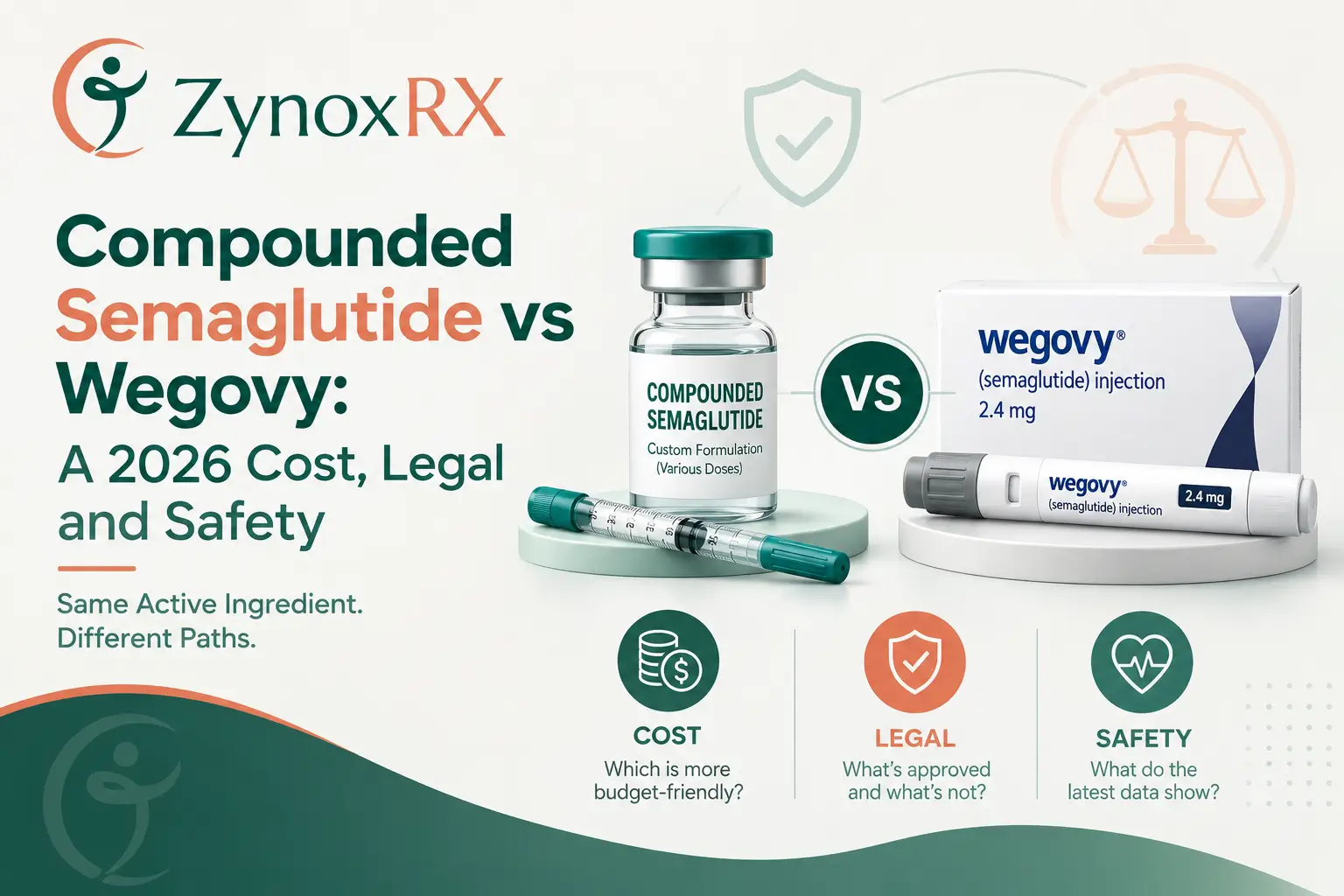
Wegovy is an FDA-approved semaglutide medication for chronic weight management. Compounded semaglutide is a non-FDA-approved preparation made by a compounding pharmacy. Until recently, the choice between compounded semaglutide vs Wegovy came down mostly to price — brand-name Wegovy carried a list price near $1,349 per month, and compounded versions sold for a fraction of that.
That gap has closed. As of 2026, Novo Nordisk sells Wegovy directly to cash-paying patients for $349 per month for the injection pen and $149 per month for the starting doses of the new oral tablet, and the regulatory position on compounded semaglutide has tightened substantially.
This page covers what separates the two products in 2026: legal status, cost, dosing and delivery, side effects, evidence base, and who compounded semaglutide is still appropriate for. It is written for adults comparing options in the United States. It is educational and is not a substitute for advice from a licensed prescriber.
At a Glance: Wegovy vs Compounded Semaglutide in 2026
|
Wegovy (semaglutide) |
Compounded semaglutide |
|
|---|---|---|
|
FDA approval |
Approved — injection (2021), tablets (Dec 2025), HD 7.2 mg pen (2026) |
Not FDA-approved; not evaluated for safety, efficacy or quality |
|
Manufacturer |
Novo Nordisk, FDA-inspected facilities |
Individual 503A pharmacies or 503B outsourcing facilities |
|
Active ingredient |
Semaglutide base |
Varies — base, or unapproved salt forms; may include added ingredients |
|
Clinical trial data |
STEP and OASIS programs, thousands of participants |
None specific to the compounded product |
|
Cash price (2026) |
$149–$399/month via NovoCare; $249–$329 on subscription tiers |
Roughly $149–$400/month, plus consult fees |
|
Delivery format |
Prefilled single-dose pen, or daily tablet |
Typically a multi-dose vial with a separate syringe |
|
Dosing |
Fixed, labelled milligram doses |
Variable concentration; may be labelled in "units" |
|
Legal status |
Unambiguous |
Narrow — patient-specific 503A compounding only, with limits |
Bottom line: In 2026, for most US adults, FDA-approved Wegovy is available at a comparable or lower cash price than compounded semaglutide, with a documented evidence base and a fixed-dose delivery device. Compounded semaglutide remains legitimate only in narrow, patient-specific clinical circumstances that a prescriber must document.
What Wegovy Is
Wegovy is Novo Nordisk's brand name for semaglutide approved for chronic weight management. Semaglutide is a GLP-1 receptor agonist: it mimics glucagon-like peptide-1, an incretin hormone that stimulates glucose-dependent insulin secretion, suppresses glucagon release, slows gastric emptying, and acts on hypothalamic appetite centres to reduce food intake.
Wegovy is now available in three FDA-approved forms:
-
Wegovy injection — once-weekly prefilled pen in 0.25 mg, 0.5 mg, 1 mg, 1.7 mg and 2.4 mg doses. First approved June 4, 2021.
-
Wegovy HD injection — a 7.2 mg once-weekly pen, approved in 2026, triple the previous 2.4 mg maximum.
-
Wegovy tablets ("the Wegovy pill") — once-daily oral semaglutide in 1.5 mg, 4 mg, 9 mg and 25 mg strengths. Approved December 22, 2025 and launched in the US in January 2026 as the first oral GLP-1 for weight management.
Wegovy is indicated for adults with obesity (BMI ≥30) or overweight (BMI ≥27) with at least one weight-related condition, and for adolescents aged 12 and older with obesity. The injection also carries indications for reducing major adverse cardiovascular events in adults with established cardiovascular disease and overweight or obesity, and for non-cirrhotic MASH.
What Compounded Semaglutide Is
Compounded drugs are prepared by a pharmacy to meet an individual patient's need that an approved product cannot meet — a documented allergy to an excipient, for example, or a required non-standard formulation. Compounding is a legitimate and long-standing part of pharmacy practice.
What compounded drugs are not is FDA-approved. As the FDA states plainly, compounded products have not been evaluated for safety, effectiveness or quality before marketing. There is no premarket review, no required bioequivalence testing against the brand, and no standardised labelling.
Two categories of compounder exist under the Federal Food, Drug, and Cosmetic Act:
-
503A pharmacies — traditional pharmacies compounding for an identified individual patient against a valid prescription. Regulated primarily by state boards of pharmacy.
-
503B outsourcing facilities — larger operations registered with the FDA that can compound in batches without patient-specific prescriptions, subject to stricter federal requirements.
That distinction matters enormously in 2026, for reasons covered in the next section. It is also the single most important question to ask any provider offering compounded semaglutide: which category is your pharmacy, and on what legal basis is it compounding this drug?
The Regulatory Picture: What Changed Between 2024 and 2026
This is where most articles on compounded semaglutide vs Wegovy are out of date, so it is worth being precise.
The shortage era (2022–2025). Semaglutide was added to the FDA drug shortage list in 2022. Federal law permits compounding of a drug that is otherwise "essentially a copy" of a commercially available product when that product is on the shortage list. Compounded GLP-1s expanded rapidly, reaching an estimated 30% of US supply at peak.
Shortage resolution (February 2025). The FDA declared the semaglutide shortage resolved. It set wind-down deadlines: enforcement discretion for 503A compounders ended April 22, 2025, and for 503B outsourcing facilities May 22, 2025. Industry litigation, including Outsourcing Facilities Association v. FDA, failed to block those deadlines — the district court denied the plaintiffs' preliminary injunction motion on April 24, 2025.
Enforcement escalation (2025–2026). More than 50 warning letters went to compounders and telehealth distributors during 2025. In February 2026 the FDA announced targeted action against non-FDA-approved GLP-1 drugs, and issued roughly 30 further warning letters to telehealth firms. A specific target of those letters: marketing claims that a compounded product is identical or equivalent to Wegovy or Ozempic. The FDA treats that claim as misleading.
The 503B bulks list proposal (April 30, 2026). The FDA proposed to exclude semaglutide, tirzepatide and liraglutide from the 503B bulks list, finding no clinical need for outsourcing facilities to compound them from bulk substances. In the agency's framing, affordability and insurance access do not constitute clinical need. The Federal Register notice published May 1, 2026; the comment period, originally closing June 30, was extended by 60 days and closed at the end of August 2026. A final determination is pending as of September 2026.
Where that leaves things. Semaglutide currently appears on neither the FDA shortage list nor the 503B bulks list. Those are the two principal lawful routes for a 503B outsourcing facility to compound from bulk API. If the April 2026 proposal is finalised, that route closes permanently — even during a future shortage.
Patient-specific compounding under 503A remains lawful, but it cannot lawfully replicate the scale of the shortage era, and it cannot lawfully produce a drug that is essentially a copy of an available approved product without a documented clinical rationale for that individual patient.
If you take one thing from this section: ask any telehealth provider to state, in writing, which pharmacy compounds their semaglutide, whether it is 503A or 503B, and what individual clinical need justifies compounding rather than the approved product. A provider whose intake never asks why a compounded formulation is medically necessary for you is not obviously operating inside the exception the law leaves open.
Cost: The Comparison That Changed Most
The $1,349 figure still anchors most coverage of this topic. Almost nobody pays it. Here is the actual 2026 landscape.
Wegovy cash prices (NovoCare Pharmacy, 2026)
|
Product |
Cash price per month |
|---|---|
|
Wegovy pen, 0.25–2.4 mg |
$349 |
|
Wegovy pen — new-patient intro (first 2 fills, 0.25/0.5 mg) |
$199 |
|
Wegovy HD pen, 7.2 mg |
$399 |
|
Wegovy pill, 1.5 mg and 4 mg |
$149 |
|
Wegovy pill, 9 mg and 25 mg |
$299 |
|
List price (all forms) |
$1,349.02 |
One month = one box of four pens, or one bottle of 30 tablets. Introductory terms run through December 31, 2026. Novo Nordisk may modify or cancel these programs.
Additional routes as of 2026:
-
Subscription tiers. Multi-month commitments through partners including Ro, WeightWatchers and LifeMD bring the pen to $329 (3-month), $299 (6-month) or $249 (12-month), and the pill to as low as $249.
-
Commercial insurance. Copays as low as $25/month where a plan covers Wegovy for obesity, subject to a $100/month maximum saving. Prior authorisation is the usual hurdle. Government beneficiaries are excluded from savings-card pricing.
-
Medicare. A flat $50/month for qualifying Part D beneficiaries under the Medicare GLP-1 arrangement effective July 1, 2026.
Compounded semaglutide pricing
Compounded semaglutide from telehealth platforms generally runs $149–$400 per month, often with a separate consultation fee and frequently quoted as a "starting at" price tied to the lowest dose. Prices commonly rise as you titrate up.
What this means in practice
The economic case that built the compounded GLP-1 market has largely dissolved. A patient starting treatment in 2026 can access FDA-approved oral Wegovy at $149/month — the same entry price as many compounded offers — or the approved injection at $199 for the first two months and $349 thereafter.
Two cautions when comparing quotes:
-
Compare like for like. A compounded "starting at" price is usually the lowest dose. Compare the price at your expected maintenance dose, not your starting dose.
-
Add the consult and membership fees. A $165/month medication with a $45 consult is not a $165/month program.
Wegovy Pill vs Compounded Semaglutide
The oral Wegovy tablet, launched January 2026, is the newest variable in this comparison and the reason a lot of older advice no longer holds.
In the OASIS 4 trial, once-daily oral semaglutide 25 mg produced a mean weight reduction of 13.6% at 64 weeks in the treatment-policy analysis, compared with 2.2–2.7% for placebo. Among participants with full treatment adherence, mean loss reached 16.6%, with roughly one-third achieving at least 20% weight loss.
Practical differences that matter when weighing the Wegovy pill against a compounded injection:
-
No needles, no vial, no syringe maths. The tablet removes the entire dosing-error pathway described below.
-
No refrigeration. Tablets are easier to travel with and store.
-
Daily, on an empty stomach. Oral semaglutide requires dosing on waking with no more than ~4 oz of water, then waiting before food, drink or other medications. Adherence demands are higher than a weekly injection.
-
Price. At $149/month for the 1.5 mg and 4 mg strengths, the pill undercuts most compounded injection programs at maintenance dosing.
If needle aversion or cost was your reason for considering a compounded product, the oral tablet addresses both without leaving the FDA-approved pathway.
Compounded Semaglutide vs Wegovy Dosage and Delivery
This is the most clinically consequential difference between the two, and the one most worth understanding before you choose.
Wegovy dosing
Wegovy injection follows a fixed, labelled escalation schedule, typically beginning at 0.25 mg once weekly and increasing at four-week intervals through 0.5 mg, 1 mg and 1.7 mg to a 2.4 mg maintenance dose, with a 7.2 mg HD option now approved. Each dose is supplied in a single-dose prefilled pen. You do not measure anything. The device delivers one dose.
Wegovy tablets follow a similar stepped escalation across the 1.5 mg, 4 mg, 9 mg and 25 mg strengths.
Compounded semaglutide dosing
Compounded semaglutide is typically supplied as a multi-dose vial with a separate syringe. The patient draws each dose. Three problems follow from that:
-
Concentration varies by compounder. There is no standard. A volume that delivers the right dose from one pharmacy's vial may deliver a very different dose from another's.
-
Units of measurement vary. Instructions may be given in milligrams, millilitres or insulin "units" — and these are not interchangeable.
-
There is no dose-limiting device. A prefilled pen physically cannot deliver ten times the intended dose. A vial and syringe can.
The documented consequence
In a July 26, 2024 safety alert, the FDA reported adverse events, some requiring hospitalisation, linked to overdoses from dosing errors with compounded injectable semaglutide. Errors came from both patients and prescribers. Patients administered five to ten times the intended dose. In one reported case a provider intending to prescribe 0.25 mg (5 units) prescribed 25 units.
The FDA noted that many patients receiving vials lacked experience with self-injection, and that unfamiliarity with drawing from a vial combined with confusion between millilitres, milligrams and "units" contributed to the errors. Reported effects included severe nausea and vomiting, abdominal pain, fainting, headache, dehydration, acute pancreatitis, gallstones and severe hypoglycaemia. Because semaglutide has a half-life of roughly one week, overdose may require a prolonged period of observation and treatment.
An independent poison-control case series published in the Journal of the American Pharmacists Association documented the same pattern, including two patients who self-administered ten-fold dosing errors, and concluded that compounded vials lack the safety features of prefilled manufactured pens.
If you are using a compounded product from a vial: have your prescriber or pharmacist show you exactly how to measure your dose with the specific syringe supplied, confirm the concentration on your vial, and never convert between units and milligrams yourself. If you are unsure whether your dose is correct, contact your prescriber before injecting.
Compounded Semaglutide vs Wegovy Side Effects
Where the active ingredient is genuinely semaglutide base at the same dose, the expected side-effect profile is the same. The difference lies in what else may be present and in dose accuracy.
Side effects associated with semaglutide
Most common, and usually mild to moderate and dose-related:
-
Nausea, vomiting, diarrhoea, constipation
-
Abdominal pain, bloating, indigestion
-
Reduced appetite, fatigue, headache
-
Injection-site reactions (injectable forms)
Serious but less common risks documented in the approved labelling include pancreatitis, gallbladder disease including gallstones, kidney injury secondary to dehydration, diabetic retinopathy complications in people with type 2 diabetes, hypoglycaemia when combined with insulin or sulfonylureas, and serious hypersensitivity reactions. Wegovy carries a boxed warning for the risk of thyroid C-cell tumours based on rodent studies.
Additional risks specific to compounded semaglutide
-
Overdose from dosing error, as described above — the best-documented compounded-specific harm.
-
Unapproved salt forms. Some compounded products have used semaglutide sodium or semaglutide acetate. These are not the active ingredient in any FDA-approved semaglutide product, and the FDA has stated they are not appropriate for compounding. Safety and effectiveness data do not transfer from the base form.
-
Variable purity and potency. Litigation brought by Novo Nordisk has alleged compounded semaglutide samples containing impurities at high levels, and hypersensitivity reactions including anaphylaxis have been raised as a concern. Sterility failures at compounding facilities have prompted recalls.
-
Added ingredients. Some compounded formulations include additives such as vitamin B12 or amino acids. These have not been studied in combination with semaglutide for weight management.
-
No standardised patient labelling. Compounded products do not carry the FDA-approved Medication Guide.
If you experience severe or persistent vomiting, severe abdominal pain radiating to the back, signs of dehydration, or symptoms of an allergic reaction, seek medical care promptly. Adverse events with compounded products can be reported to the FDA's MedWatch program.
Effectiveness: What the Evidence Actually Supports
Wegovy. In the STEP 1 trial, once-weekly semaglutide 2.4 mg produced a mean body-weight reduction of 14.9% at 68 weeks, versus 2.4% with placebo. The oral 25 mg tablet produced 13.6% at 64 weeks in OASIS 4. These are large, randomised, placebo-controlled trials in the specific approved formulations.
Compounded semaglutide. No compounded semaglutide product has been studied in a clinical trial. Where a compounded preparation contains semaglutide base at an equivalent dose, similar pharmacology would be expected — but expectation is not evidence, and it does not account for variability in potency, purity or actual delivered dose between pharmacies and between vials.
This is why claims that a compounded product delivers "the same results as Wegovy" are not supportable, and why the FDA has cited that framing in warning letters. Anyone telling you a compounded product is equivalent to Wegovy is making a claim no data supports.
Who Might Legitimately Need Compounded Semaglutide
Compounding exists for real clinical reasons, and dismissing it entirely would be as inaccurate as overselling it. Situations where a prescriber may document a genuine patient-specific need include:
-
A documented allergy or intolerance to an excipient in the approved product
-
A clinically justified dose that no approved strength can provide
-
A required formulation change that the approved product cannot accommodate
What the FDA has explicitly said does not constitute clinical need: cost, insurance coverage, and general convenience or preference.
If cost is your reason for considering compounded semaglutide, the honest answer in 2026 is that the approved product is now likely to cost the same or less. If a clinical reason applies to you, that is a conversation to have with a licensed prescriber who documents it in your record.
Who Should Not Take Semaglutide in Any Form
This applies equally to Wegovy and to compounded semaglutide. Discuss all of these with a licensed medical provider before starting treatment.
Absolute contraindications:
-
Personal or family history of medullary thyroid carcinoma (MTC)
-
Multiple Endocrine Neoplasia syndrome type 2 (MEN 2)
-
Known serious hypersensitivity to semaglutide or any component of the formulation
Pregnancy and breastfeeding. Semaglutide is not recommended during pregnancy and should be discontinued at least two months before a planned pregnancy because of its long half-life. It is not recommended while breastfeeding. Effective contraception is advised during treatment. This applies to compounded and approved products alike.
Requires caution and prescriber assessment:
-
History of pancreatitis
-
Gallbladder disease or history of gallstones
-
Type 2 diabetes, particularly on insulin or sulfonylureas (hypoglycaemia risk)
-
Diabetic retinopathy
-
Severe kidney impairment or conditions predisposing to dehydration
-
Severe gastrointestinal disease, including gastroparesis
-
History of eating disorders
-
Suicidal ideation or a history of suicidal behaviour — discuss monitoring with your provider
-
Planned surgery or procedures requiring anaesthesia — inform your surgical and anaesthesia team, as delayed gastric emptying affects fasting guidance
-
Use of other GLP-1 receptor agonists — never combine semaglutide-containing products
Semaglutide has not been established as safe or effective in combination with other weight-loss products, including over-the-counter and herbal preparations.
Medical Disclaimer
The information on this page is for educational purposes only and does not constitute medical advice. It does not establish a provider–patient relationship. Compounded medications are not FDA-approved and have not been evaluated by the FDA for safety, effectiveness or quality. Individual results vary. Do not start, stop or change any prescription medication based on this page. Consult a qualified licensed medical practitioner like ZynoxRX to determine what treatment, if any, is appropriate for your specific health circumstances.
Frequently Asked Questions
What is the difference between compounded semaglutide and Wegovy?
Wegovy is an FDA-approved medication manufactured by Novo Nordisk in FDA-inspected facilities, supplied in fixed labelled doses and supported by large clinical trials. Compounded semaglutide is prepared by a compounding pharmacy, is not FDA-approved, has not been evaluated for safety, effectiveness or quality, and may vary in concentration, purity and added ingredients between pharmacies. The delivery format also differs: Wegovy uses a prefilled single-dose pen or a tablet, while compounded semaglutide is usually a multi-dose vial requiring the patient to draw each dose.
Is compounded semaglutide legal in 2026?
Patient-specific compounding under Section 503A remains legal where a prescriber documents an individual clinical need that the approved product cannot meet. Large-scale compounding is not: semaglutide is on neither the FDA shortage list nor the 503B bulks list, and in April 2026 the FDA proposed formally excluding it from the bulks list, finding no clinical need. A final determination is pending. Cost and insurance coverage do not qualify as clinical need under the FDA's framework.
Should I choose compounded semaglutide or Wegovy?
For most US adults in 2026, FDA-approved Wegovy is the more straightforward choice: it costs $149–$349 per month in cash through NovoCare, comes in fixed doses that remove the risk of measurement error, and is supported by trial evidence. Compounded semaglutide is appropriate only where a licensed prescriber documents a specific clinical reason the approved product cannot be used. Bring both options to a prescriber rather than deciding on price alone.
Is compounded semaglutide as effective as Wegovy?
No compounded semaglutide product has been tested in a clinical trial, so there is no evidence establishing equivalence. Where a compounded preparation contains semaglutide base at an equivalent dose, similar effects would be expected pharmacologically — but potency and purity vary between compounders, and the actual delivered dose depends on correct measurement by the patient. Claims that a compounded product produces the same results as Wegovy are not supported by data, and the FDA has cited such claims in warning letters.
How does compounded semaglutide dosage compare with the Wegovy pen?
Wegovy injection uses a fixed escalation schedule — typically 0.25 mg weekly, stepping up at four-week intervals to a 2.4 mg maintenance dose — delivered by a single-dose prefilled pen that requires no measurement. Compounded semaglutide is usually supplied in a multi-dose vial at a concentration that varies by pharmacy, with instructions that may be written in milligrams, millilitres or insulin "units." The FDA has documented patients administering five to ten times their intended dose because of this. Never convert between units and milligrams yourself; ask your prescriber to demonstrate the exact measurement with your specific syringe.
Are the side effects of compounded semaglutide and Wegovy the same?
The expected side effects of semaglutide itself — nausea, vomiting, diarrhoea, constipation, abdominal pain, reduced appetite — are the same where the active ingredient and dose match. Compounded products carry additional risks: overdose from dosing errors, unapproved salt forms such as semaglutide sodium or acetate, variable purity, added ingredients that have not been studied alongside semaglutide, sterility concerns, and no FDA-approved Medication Guide. Both carry the serious risks in semaglutide's labelling, including a boxed warning for thyroid C-cell tumours.
Is the Wegovy pill better than compounded semaglutide?
The Wegovy pill is FDA-approved, requires no needles or dose measurement, needs no refrigeration, and starts at $149 per month for the 1.5 mg and 4 mg strengths — comparable to or below most compounded programs. In OASIS 4, oral semaglutide 25 mg produced 13.6% mean weight loss at 64 weeks. The trade-off is a daily dosing routine on an empty stomach, which demands more adherence than a weekly injection. For patients whose reason for considering a compounded product was cost or needle aversion, the tablet addresses both within the approved pathway.
What questions should I ask a telehealth provider offering compounded semaglutide?
Ask which specific pharmacy compounds the product and whether it is a 503A pharmacy or a 503B outsourcing facility. Ask what individual clinical need justifies a compounded product rather than the approved one, and confirm it is documented in your record. Ask for the exact concentration of your vial and whether a certificate of analysis for potency and sterility is available. Ask whether the semaglutide is the base form rather than a salt form. Be cautious of any provider describing a compounded product as "FDA-approved" or as identical to Wegovy — the FDA has issued warning letters over both claims.
References
Food and Drug Administration. (2024, July 26). FDA alerts health care providers, compounders and patients of dosing errors associated with compounded injectable semaglutide products. U.S. Department of Health and Human Services. https://www.fda.gov
Food and Drug Administration. (2025). FDA clarifies policies for compounders as national GLP-1 supply begins to stabilize. https://www.fda.gov/drugs/drug-alerts-and-statements/fda-clarifies-policies-compounders-national-glp-1-supply-begins-stabilize
Food and Drug Administration. (2026, April 30). FDA proposes to exclude semaglutide, tirzepatide, and liraglutide on 503B bulks list [Press release]. https://www.fda.gov/news-events/press-announcements/fda-proposes-exclude-semaglutide-tirzepatide-and-liraglutide-503b-bulks-list
Food and Drug Administration. (2026, May 1). List of bulk drug substances for which there is a clinical need under section 503B of the Federal Food, Drug, and Cosmetic Act. Federal Register, 91, 23431–23444. https://www.federalregister.gov/documents/2026/05/01/2026-08552
Food and Drug Administration. (2026, June 26). List of bulk drug substances for which there is a clinical need under section 503B of the Federal Food, Drug, and Cosmetic Act; Extension of comment period. Federal Register. https://www.federalregister.gov/documents/2026/06/26/2026-12937
Muller, C., Hoegberg, L. C. G., & colleagues. (2023). Administration errors of compounded semaglutide reported to a poison control center — Case series. Journal of the American Pharmacists Association. https://pubmed.ncbi.nlm.nih.gov/37392810/
Novo Nordisk. (2026, January 5). Novo Nordisk's Wegovy pill, the first and only oral GLP-1 for weight loss in adults, now broadly available across America [Press release]. https://www.prnewswire.com/news-releases/novo-nordisks-wegovy-pill-the-first-and-only-oral-glp-1-for-weight-loss-in-adults-now-broadly-available-across-america-302652205.html
NovoCare. (2026). Wegovy (semaglutide) cost, coverage, and savings resources. Novo Nordisk. https://www.novocare.com/patient/medicines/wegovy.html
Wilding, J. P. H., Batterham, R. L., Calanna, S., Davies, M., Van Gaal, L. F., Lingvay, I., McGowan, B. M., Rosenstock, J., Tran, M. T. D., Wadden, T. A., Wharton, S., Yokote, K., Zeuthen, N., & Kushner, R. F. (2021). Once-weekly semaglutide in adults with overweight or obesity. New England Journal of Medicine, 384(11), 989–1002. https://doi.org/10.1056/NEJMoa2032183