503A vs 503B Compounding Pharmacy: 2026 FDA Rules Explained
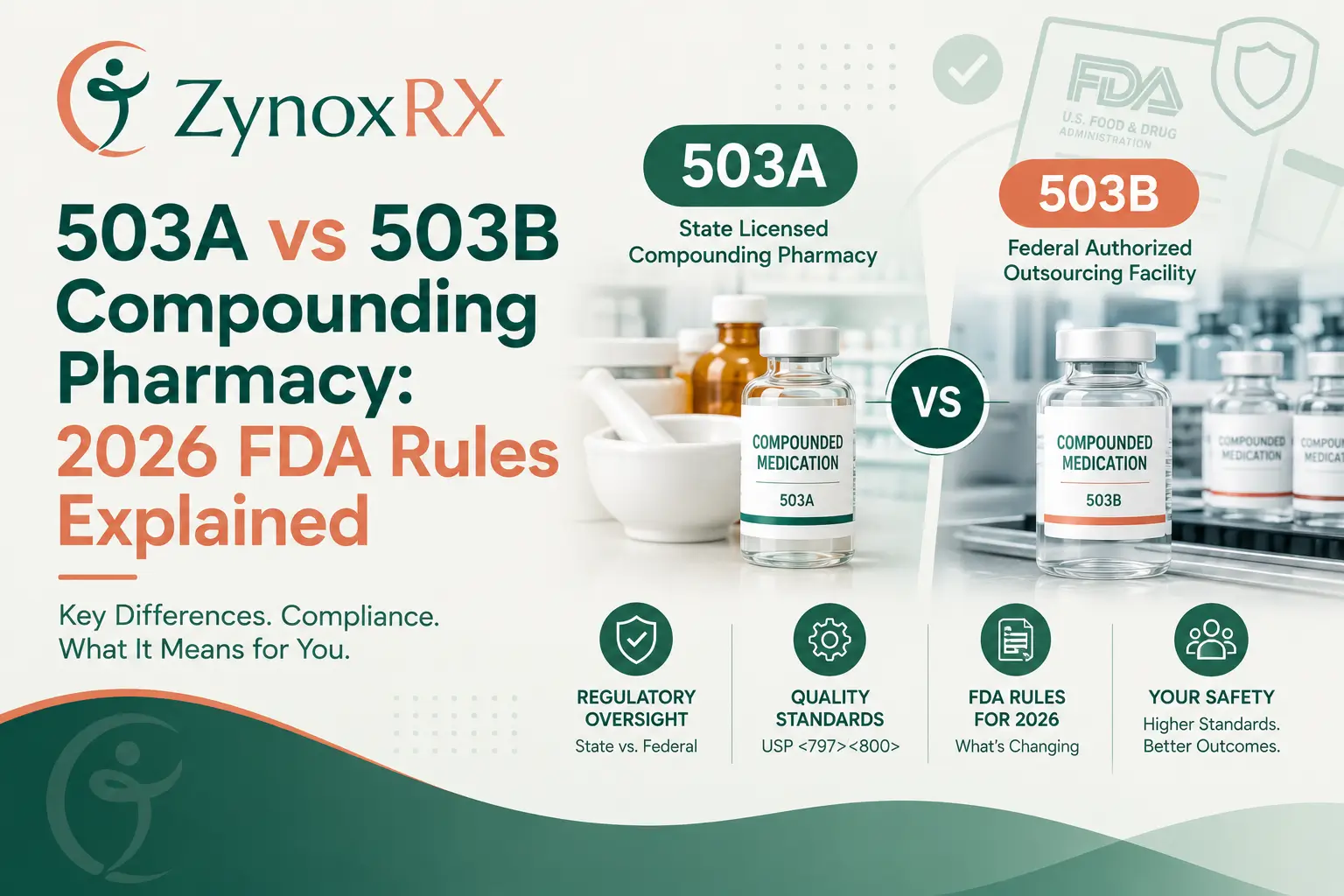
503A and 503B are two sections of the same federal law. They describe two different kinds of compounder, with different rules about who they can make medication for, how much they can make at a time, and who inspects them.
If you receive a compounded medication — a GLP-1, a hormone preparation, a peptide — the section your pharmacy operates under determines what it is legally permitted to send you. In 2026 that stopped being a technicality. The FDA has an open proposal that would permanently close bulk compounding of semaglutide, tirzepatide, and liraglutide, and a separate July advisory vote reopened the question of peptides.
This page covers what each designation means in practice, a full side-by-side comparison, exactly where the 2026 rules stand as of publication, and how to verify a pharmacy's license before you order anything.
503A vs 503B Compounding Pharmacy: The Short Answer
A 503A compounding pharmacy is a state-licensed pharmacy that prepares a medication for one named patient with a valid prescription. It is regulated primarily by its state board of pharmacy and follows United States Pharmacopeia standards. A 503B outsourcing facility registers voluntarily with the FDA, follows federal current good manufacturing practice (CGMP) rules, may compound in large batches without a patient-specific prescription, and sells to clinics and hospitals for office use.
Neither produces FDA-approved drugs. Compounded preparations do not go through premarket review for safety, effectiveness, or quality — that is true at both tiers, and it is the single most misunderstood fact in this entire category.
Side-by-Side Comparison
|
503A Compounding Pharmacy |
503B Outsourcing Facility |
|
|---|---|---|
|
Statutory basis |
Section 503A, FD&C Act (1997, amended 2013) |
Section 503B, FD&C Act (added by DQSA, 2013) |
|
Primary regulator |
State board of pharmacy |
FDA (direct federal oversight) |
|
FDA registration |
Not required |
Voluntary, but required to operate as a 503B |
|
Patient-specific prescription |
Required before compounding |
Not required |
|
Office-use / bulk supply to clinics |
Not permitted |
Permitted |
|
Quality standard |
USP <795>, <797>, <800> + state rules |
CGMP (21 CFR 210/211) + USP + state rules |
|
Batch release testing |
Not routinely required |
Required — every batch tested before release |
|
FDA inspection |
For cause, limited scope |
Risk-based schedule, routine |
|
Beyond-use dating |
Typically shorter, USP-derived |
Typically longer, stability-data supported |
|
Bulk substance rules |
Must have a USP/NF monograph, be a component of an FDA-approved drug, or appear on the 503A Bulks List |
Must appear on the 503B Bulks List, or the drug must be on FDA's shortage list at time of compounding |
|
Adverse event reporting |
Not federally mandated under 503A |
Mandatory to FDA |
|
Product reporting to FDA |
No |
Twice yearly |
|
Typical use case |
Allergy-free formulation, custom dose, alternate dosage form for one patient |
Sterile injectables stocked by a clinic, hospital anaesthesia trays, batch preparations |
|
Cannot do |
Compound copies of commercially available drugs "regularly or in inordinate amounts"; supply office stock |
Compound copies of approved drugs; use bulk substances outside the two pathways above |
Both designations exist for a reason. Neither is universally "safer" — the honest framing is that they are built for different jobs, and using one for the other's job is where problems start.
What Is a 503A Compounding Pharmacy?
This is the traditional model. A pharmacist receives a prescription written for a specific, named patient and prepares that medication to order.
The clinical case for it is narrow and real. A child who cannot swallow a tablet needs a suspension. A patient reacts to a dye or preservative in the commercial product and needs it without. A prescriber needs a strength that is not manufactured. These are the situations Section 503A was written to preserve.
What 503A pharmacies cannot do:
-
No office stock. A 503A cannot lawfully batch a product and sell it to a clinic as undifferentiated inventory. If a supplier offers you a compounded injectable with no patient-specific prescription attached, that is outside the 503A lane.
-
No routine copies. Section 503A prohibits compounding drugs that are "essentially a copy" of a commercially available product regularly or in inordinate amounts. FDA has stated it does not intend to act against a compounder filling four or fewer prescriptions of a given essentially-a-copy product in a calendar month (National Association of Boards of Pharmacy, 2026). That is a narrow enforcement position, not a licence to operate at scale.
-
No unrestricted ingredient list. Bulk drug substances must meet one of three tests: an applicable USP or NF monograph, status as a component of an FDA-approved drug, or inclusion on the 503A Bulks List (U.S. Food and Drug Administration, n.d.-a).
503A pharmacies are not subject to CGMP. In practice that means potency, sterility, and stability are generally not verified by lot testing the way they are at a 503B. Some 503A pharmacies test far beyond what is required. Many do not. The designation alone does not tell you which one you are dealing with.
What Is a 503B Outsourcing Facility?
Section 503B was created by the Drug Quality and Security Act in 2013, directly in response to a 2012 fungal meningitis outbreak traced to contaminated steroid injections from a single Massachusetts compounder. That outbreak caused dozens of deaths and hundreds of infections across 20 states, and it exposed a gap: a facility manufacturing at industrial scale while regulated as a neighbourhood pharmacy.
A 503B registers with the FDA and accepts federal oversight in exchange for two commercial freedoms: it may compound without a patient-specific prescription, and it may sell to healthcare facilities for office use.
What that oversight actually involves:
-
Full CGMP compliance under 21 CFR Parts 210 and 211 — the same framework that applies to commercial drug manufacturers
-
Validated processes, equipment, cleanrooms, and analytical methods
-
Release testing on every batch before distribution
-
Routine, risk-based FDA inspection
-
Twice-yearly product reporting to the FDA and mandatory adverse event reporting
-
An annual establishment fee
The bulk substance constraint is where 503B facilities are boxed in. An outsourcing facility generally cannot compound from a bulk drug substance unless that substance appears on the 503B Bulks List — FDA's list of substances for which it has found a clinical need — or the resulting drug is on FDA's shortage list at the time of compounding, distribution, and dispensing (U.S. Food and Drug Administration, n.d.-b).
Those two doors are the whole story of 2026.
The FDA's 2026 Proposal: What It Actually Says
On April 30, 2026, the FDA announced it was proposing to exclude semaglutide, tirzepatide, and liraglutide from the 503B Bulks List, finding no clinical need for outsourcing facilities to compound these drugs from bulk substances (U.S. Food and Drug Administration, 2026a). The formal notice was published in the Federal Register on May 1 (91 Fed. Reg. 23431, Docket No. FDA-2018-N-3240).
Here is what makes this different from previous FDA actions on GLP-1s. Every prior restriction was tied to shortage status, which is a moving target — a drug goes into shortage, compounding opens; the shortage resolves, compounding closes. A bulks-list exclusion is structural. If finalized as written, it would bar 503B facilities from compounding these three substances from bulk API regardless of future market conditions.
Timeline: How the Door Closed
|
Date |
Event |
|---|---|
|
2022 |
Semaglutide, tirzepatide, and liraglutide added to FDA's drug shortage list amid surging demand |
|
2022–2024 |
Large-scale compounding expands; compounded GLP-1s widely offered at roughly $150–$300/month against branded list prices above $1,000 (Pharmacy Times, 2026) |
|
Oct 2024 / Dec 2024 |
FDA determines the tirzepatide shortage is resolved, then reaffirms that determination on reevaluation |
|
Feb 21, 2025 |
FDA issues a declaratory order resolving the semaglutide shortage |
|
Apr–May 2025 |
Wind-down deadlines pass: 503A pharmacies by April 22, 2025; 503B facilities by May 22, 2025 |
|
2025 |
Outsourcing Facilities Association litigation fails to secure preliminary injunctions |
|
Apr 30, 2026 |
FDA proposes excluding all three substances from the 503B Bulks List |
|
Jun 26, 2026 |
Comment period extended by 30 days following a request for more time |
|
Jul 30, 2026 |
Comment period closes with several thousand comments filed |
|
As of publication |
No final determination announced |
"Clinical Need" Does Not Mean "Cheaper"
This is the part that gets misreported, and it is the load-bearing legal point.
FDA's clinical-need standard asks whether there is a medical reason a patient cannot be treated with the approved product. Cost is not that reason. Insurance coverage is not that reason. The agency has been explicit that supply constraints and price considerations are distinct from clinical need. FDA Commissioner Marty Makary framed the April announcement in exactly those terms: when FDA-approved drugs are available, outsourcing facilities cannot lawfully compound from bulk substances without a clear clinical need (U.S. Food and Drug Administration, 2026a).
You can disagree with that policy — many patients and pharmacy groups do, and several thousand of them said so in the docket. But it is the standard the final rule will be judged against, and affordability arguments have not moved it so far.
Safety Data in the Record
FDA has pointed to adverse event reporting as part of its rationale. As of early 2025, the agency had received more than 455 adverse event reports linked to compounded semaglutide and more than 320 linked to compounded tirzepatide, a substantial share involving dosing errors by patients self-administering from multi-dose vials (Pharmacy Times, 2026). Concerns about unapproved salt forms and impurity profiles in some compounded products also feature in the record.
Dosing errors are the recurring theme. A patient handed a vial and a syringe, converting a prescribed milligram dose into units, is a different risk profile from a pre-filled pen.
Where Compounded GLP-1s Legally Stand Right Now
This section is the one most competitor pages get wrong or quietly skip. Here is the status as of publication.
|
Substance |
On FDA shortage list? |
On 503B Bulks List? |
503B bulk compounding |
503A patient-specific |
|---|---|---|---|---|
|
Semaglutide |
No — resolved Feb 2025 |
No — proposed for exclusion |
Not available |
Only on a documented clinical difference for the individual patient |
|
Tirzepatide |
No — resolved 2024 |
No — proposed for exclusion |
Not available |
Only on a documented clinical difference for the individual patient |
|
Liraglutide |
Yes — still listed, with presentations reported available or limited |
No — proposed for exclusion |
Available only while shortage status holds |
Narrow, same standard |
Two things follow from that table.
First, for semaglutide and tirzepatide, both legal doors are shut. Neither substance is on the shortage list, and neither is on the 503B Bulks List. Any marketing that presents compounded versions of these two as routinely and lawfully available at scale is not describing the current framework.
Second, 503A patient-specific compounding is still legal — but it is narrow. FDA does not treat a compounded product as "essentially a copy" if the prescriber documents a clinical difference for that individual patient on the prescription. A documented excipient allergy or a strength that is not commercially manufactured can meet that bar. Preferring a lower price does not.
Liraglutide's status is the genuine grey area and the most volatile line in this article. Shortage listings change without much notice. Verify the current entry in FDA's Drug Shortages database before relying on it.
Reader check: If a provider or platform offers you compounded semaglutide or tirzepatide with no patient-specific prescription and no documented clinical justification, ask directly which pathway they are operating under and request it in writing. A compliant pharmacy will answer that question without hesitation.
503A or 503B for Peptides? What the July 2026 Vote Did — and Didn't — Do
Peptides are where the search interest has moved, and where the misinformation is thickest.
The sequence of events:
In April 2026, the FDA announced it would remove twelve peptide bulk drug substances from Category 2 of its interim 503A bulks framework — the category reserved for substances raising significant safety concerns — effective later that month. Removal from Category 2 is a procedural step that makes a substance eligible for review. It is not authorisation to compound, and FDA's interim policy does not extend enforcement discretion to substances simply because they left Category 2.
On July 23–24, 2026, the Pharmacy Compounding Advisory Committee met at FDA's White Oak campus (Docket No. FDA-2026-N-2979) to consider seven peptides for the 503A Bulks List: BPC-157, KPV, TB-500, MOTS-c, emideltide (DSIP), semax, and epitalon. By narrow margins, the committee recommended six of the seven; it voted against emideltide (Regulatory Affairs Professionals Society, 2026).
Three things that vote did not do:
-
It did not change the law. PCAC recommendations are non-binding. These peptides still cannot be lawfully compounded, and FDA retains authority to act against pharmacies that compound them (Holland & Knight, 2026).
-
It did not reflect FDA's own scientific assessment. Agency reviewers recommended against all seven, citing incomplete chemical characterisation, thin human clinical data, and immunogenicity concerns. The committee voted the other way. That split is unusual and worth understanding before reading the outcome as a safety endorsement.
-
It did not set a timeline. Adding a substance to the 503A Bulks List requires notice-and-comment rulemaking, which routinely takes a year or more. FDA could shorten the practical gap by announcing enforcement discretion, but it has not done so as of publication. A further PCAC meeting covering five additional peptides is expected in early 2027.
What this means if you are shopping for peptides right now: a pharmacy advertising these compounds as newly legal is ahead of the regulation. Material sold as "research use only" or "research grade" sits outside the pharmacy supply chain entirely and carries no assurance of identity, purity, or sterility. Neither a 503A nor a 503B designation makes an unlisted bulk substance lawful to compound.
503A vs 503B: Which Is Better?
Wrong question, in most cases. The right question is which one fits the job.
Choose a 503A when:
-
You need a formulation genuinely customised to one patient — allergen removed, alternate dosage form, non-commercial strength
-
A prescriber has documented why the approved product will not work for you specifically
-
The preparation is non-sterile or lower-risk
Choose a 503B when:
-
The product is a sterile injectable and batch-verified potency and sterility matter
-
A clinic needs stocked inventory rather than named-patient dispensing
-
You want the assurance of CGMP compliance and routine FDA inspection
Neither is appropriate when:
-
An FDA-approved product exists, is available, and is clinically suitable for you. In that case the approved product is the one that has actually been reviewed for safety, effectiveness, and manufacturing quality.
The pattern to watch for is a mismatch: a 503A supplying office stock, or any compounder producing copies of an available approved drug at volume. Both are compliance failures, and both have historically preceded recalls.
How to Verify a Licensed 503A or 503B Compounding Pharmacy
Do this before you order. It takes about ten minutes.
- Check the 503B registration directly. FDA publishes a current list of registered outsourcing facilities. If a company describes itself as a 503B, its legal name should appear there. If it does not, it is not a 503B, whatever the marketing says.
- Check the state licence. Look up the pharmacy in the licensee database of the state board of pharmacy where it operates — and, separately, whether it holds a non-resident licence in your state. Both matter. The National Association of Boards of Pharmacy maintains links to every state board.
- Ask which pathway applies to your specific medication. Not "are you licensed" — that is a yes/no anyone will pass. Ask: Which bulk substance pathway are you using for this drug, and is that substance currently on the applicable list? Legitimate compounders answer this precisely.
- Request the certificate of analysis. For any sterile injectable, ask for the lot's CoA covering potency and sterility. A 503B will have one for every batch as a matter of course. A 503A may not — and that answer is itself informative.
- Check FDA enforcement history. Search the facility name against FDA's warning letter database and recall announcements. FDA has issued warning letters to compounders and telehealth distributors over compounded GLP-1 marketing claims, including claims of equivalence to branded products.
- Verify the prescriber relationship. A compounded medication requires a valid prescription from a licensed provider who has evaluated you. A platform that ships without one is not operating inside either framework.
Risks, Limitations, and Who Should Not Use Compounded Medications
Compounded preparations are not FDA-approved. They have not undergone premarket review for safety, effectiveness, or manufacturing quality. That applies at both 503A and 503B tiers, and it does not by itself mean a preparation is unsafe — it means the responsibility for judging necessity and risk sits with your prescriber rather than with a regulatory review.
Documented risks associated with compounded preparations include:
-
Variable potency — sub- or super-potent product relative to the labelled strength
-
Sterility failures in injectable products, which have caused serious infections and deaths
-
Impurities, degradation products, and unapproved salt forms not present in the approved drug
-
Dosing errors, particularly when patients draw doses from multi-dose vials
-
Allergic and hypersensitivity reactions to excipients or ingredients
A compounded GLP-1 or peptide preparation may be inappropriate, and you should not proceed without a full clinical evaluation, if any of the following apply:
-
Personal or family history of medullary thyroid carcinoma, or Multiple Endocrine Neoplasia syndrome type 2 (a contraindication for GLP-1 receptor agonists)
-
Pregnancy, planned pregnancy, or breastfeeding — state this explicitly to your provider
-
History of pancreatitis, gallbladder disease, or severe gastrointestinal disease including gastroparesis
-
Known allergy or prior reaction to the active ingredient, an excipient, or a preservative
-
Type 1 diabetes, or diabetic retinopathy requiring monitoring
-
Severe renal or hepatic impairment
-
Current use of other GLP-1 receptor agonists or interacting medications
-
History of eating disorders, or a BMI below the threshold for pharmacological weight management
-
Any active infection or condition requiring treatment before initiating therapy
This list is a starting point, not a complete assessment. Only a licensed clinician who has reviewed your full history can determine suitability.
Medical disclaimer: The information on this page is for educational purposes only and does not constitute medical or legal advice. Compounded medications are not FDA-approved and are not equivalent to Ozempic®, Wegovy®, Mounjaro®, Zepbound®, Victoza®, or Saxenda®. Individual results may vary. Regulatory status described here reflects publicly available FDA information as of the review date shown and may change. Consult a qualified licensed practitioner before starting, stopping, or changing any treatment.
Talk to a Licensed Provider Before You Decide
The distinction between 503A and 503B matters most at the point where someone is about to send you an injectable. If you are weighing a compounded option, the useful next step is a clinical conversation — not a checkout page.
Start a free eligibility assessment → — reviewed by an independent, licensed US physician. No insurance required.
Prefer to read first? See how the consultation process works, review our licensed providers, or check availability in your state.
Frequently Asked Questions
What is the main difference between a 503A and a 503B compounding pharmacy?
A 503A pharmacy compounds for one named patient with a valid prescription and is regulated primarily by its state board of pharmacy. A 503B outsourcing facility registers with the FDA, follows federal CGMP manufacturing standards, and may compound in bulk without a patient-specific prescription for office use. Neither produces FDA-approved drugs.
Is a 503B safer than a 503A?
503B facilities operate under stricter, federally enforced quality controls, including batch release testing and routine FDA inspection, so a 503B product carries more verification. That does not make 503A compounding unsafe or make 503B products FDA-approved. The right comparison is fit for purpose: patient-specific customisation is a 503A function; verified sterile batch production is a 503B function.
Can a 503A pharmacy sell medication to a clinic for office use?
No. Supplying office stock without patient-specific prescriptions falls outside Section 503A. A 503A doing this is operating outside its legal framework, and prescribers who order that way may be creating compliance exposure for both parties.
Can I still get compounded semaglutide or tirzepatide in 2026?
Not through routine bulk compounding. Both shortages have been resolved, neither substance is on the 503B Bulks List, and the FDA has proposed permanently excluding both. A 503A pharmacy may still compound for an individual patient where the prescriber documents a clinical difference the approved product cannot meet — an excipient allergy, for example. Cost is not an accepted justification. Verify current status with FDA before relying on any of this.
What did the FDA propose in 2026, and has it been finalized?
On April 30, 2026, FDA proposed excluding semaglutide, tirzepatide, and liraglutide from the 503B Bulks List, finding no clinical need for outsourcing facilities to compound them from bulk substances. The Federal Register notice published May 1, 2026, and the comment period closed July 30, 2026 after a 30-day extension. As of this page's review date, no final determination has been announced.
Are compounded peptides like BPC-157 legal now?
No. In July 2026 an FDA advisory committee recommended six of seven reviewed peptides for the 503A Bulks List, but those recommendations are non-binding and did not change the law. FDA's own scientific reviewers had recommended against all seven. Formal rulemaking is required before these substances can be lawfully compounded, and that process typically takes over a year.
Can a 503A pharmacy compound peptides?
Only if the bulk substance meets one of three conditions: it has an applicable USP or NF monograph, it is a component of an FDA-approved drug, or it appears on the 503A Bulks List. Most popular wellness peptides meet none of these. Material marketed as "research use only" is outside the pharmacy supply chain entirely.
How do I check if a compounding pharmacy is licensed?
Search FDA's registered outsourcing facility list for 503B status, then verify the state board of pharmacy licence in both the pharmacy's home state and your own state. Ask which bulk substance pathway applies to your specific medication, request the certificate of analysis for sterile injectables, and check the facility name against FDA warning letters and recalls.
Does a 503B outsourcing facility need to be a licensed pharmacy?
Not necessarily. A 503B must operate under the direct supervision of a licensed pharmacist but is not required to be a licensed pharmacy itself. This is why FDA's preferred term is "503B outsourcing facility" rather than "503B pharmacy."
Are compounded medications covered by insurance?
Usually not. Most compounded preparations are cash-pay. Because they are not FDA-approved, they generally fall outside formulary coverage, and manufacturer copay assistance for the branded product does not apply.
References
Holland & Knight. (2026, August). FDA advisory committee endorses compounding of certain peptides. https://www.hklaw.com/en/insights/publications/2026/08/fda-advisory-committee-endorses-compounding-of-certain-peptides
National Association of Boards of Pharmacy. (2026). FDA clarifies policies for compounding drugs under sections 503A and 503B of FD&C Act. https://nabp.pharmacy/news/blog/regulatory_news/fda-clarifies-policies-compounding-drugs-sections-503a-and-503b/
Pharmacy Times. (2026). FDA moves to permanently close the door on compounded GLP-1s. https://www.pharmacytimes.com/view/fda-moves-to-permanently-close-the-door-on-compounded-glp-1s
Regulatory Affairs Professionals Society. (2026, July 24). FDA advisory committee backs two more peptides, rejects one for compounding list. https://www.raps.org/resource/fda-advisory-committee-backs-two-more-peptides-rejects-one-for-compounding-list.html
U.S. Food and Drug Administration. (n.d.-a). Bulk drug substances used in compounding under section 503A of the FD&C Act. https://www.fda.gov/drugs/human-drug-compounding/bulk-drug-substances-used-compounding-under-section-503a-fdc-act
U.S. Food and Drug Administration. (n.d.-b). FD&C Act provisions that apply to human drug compounding. https://www.fda.gov/drugs/human-drug-compounding/fdc-act-provisions-apply-human-drug-compounding
U.S. Food and Drug Administration. (2025, February). FDA clarifies policies for compounders as national GLP-1 supply begins to stabilize. https://www.fda.gov/drugs/drug-alerts-and-statements/fda-clarifies-policies-compounders-national-glp-1-supply-begins-stabilize
U.S. Food and Drug Administration. (2026a, April 30). FDA proposes to exclude semaglutide, tirzepatide, and liraglutide on 503B bulks list. https://www.fda.gov/news-events/press-announcements/fda-proposes-exclude-semaglutide-tirzepatide-and-liraglutide-503b-bulks-list
U.S. Food and Drug Administration. (2026b, May 1). List of bulk drug substances for which there is a clinical need under section 503B of the Federal Food, Drug, and Cosmetic Act. Federal Register, 91(84), 23431–23444. Docket No. FDA-2018-N-3240. https://www.federalregister.gov/documents/2026/05/01/2026-08552/list-of-bulk-drug-substances-for-which-there-is-a-clinical-need-under-section-503b-of-the-federal
U.S. Food and Drug Administration. (2026c, June 26). List of bulk drug substances for which there is a clinical need under section 503B of the Federal Food, Drug, and Cosmetic Act; Extension of comment period. Federal Register. https://www.federalregister.gov/documents/2026/06/26/2026-12937/list-of-bulk-drug-substances-for-which-there-is-a-clinical-need-under-section-503b-of-the-federal
U.S. Food and Drug Administration. (2026d, July). July 23–24, 2026: Meeting of the Pharmacy Compounding Advisory Committee. Docket No. FDA-2026-N-2979. https://www.fda.gov/advisory-committees/advisory-committee-calendar/july-23-24-2026-meeting-pharmacy-compounding-advisory-committee-07232026